
Scaffold load spread mats
ALIMATS® for Scaffolding
Interlocking aluminium mats that spread scaffold leg loads over a larger area, for when the ground, slab or surface beneath cannot take them through a base plate alone.
- Fully certified aluminium
- Laid by hand, no plant
- Single day to long-term hire
- Nationwide delivery, 24/7
- Mat sizes
- 0.33–8.07m²
- Module weight
- 13–48kg
- Hire periods
- From 1 day
- Nationwide delivery
- 24/7
Why spread scaffold loads?
A scaffold is only as stable as what it stands on
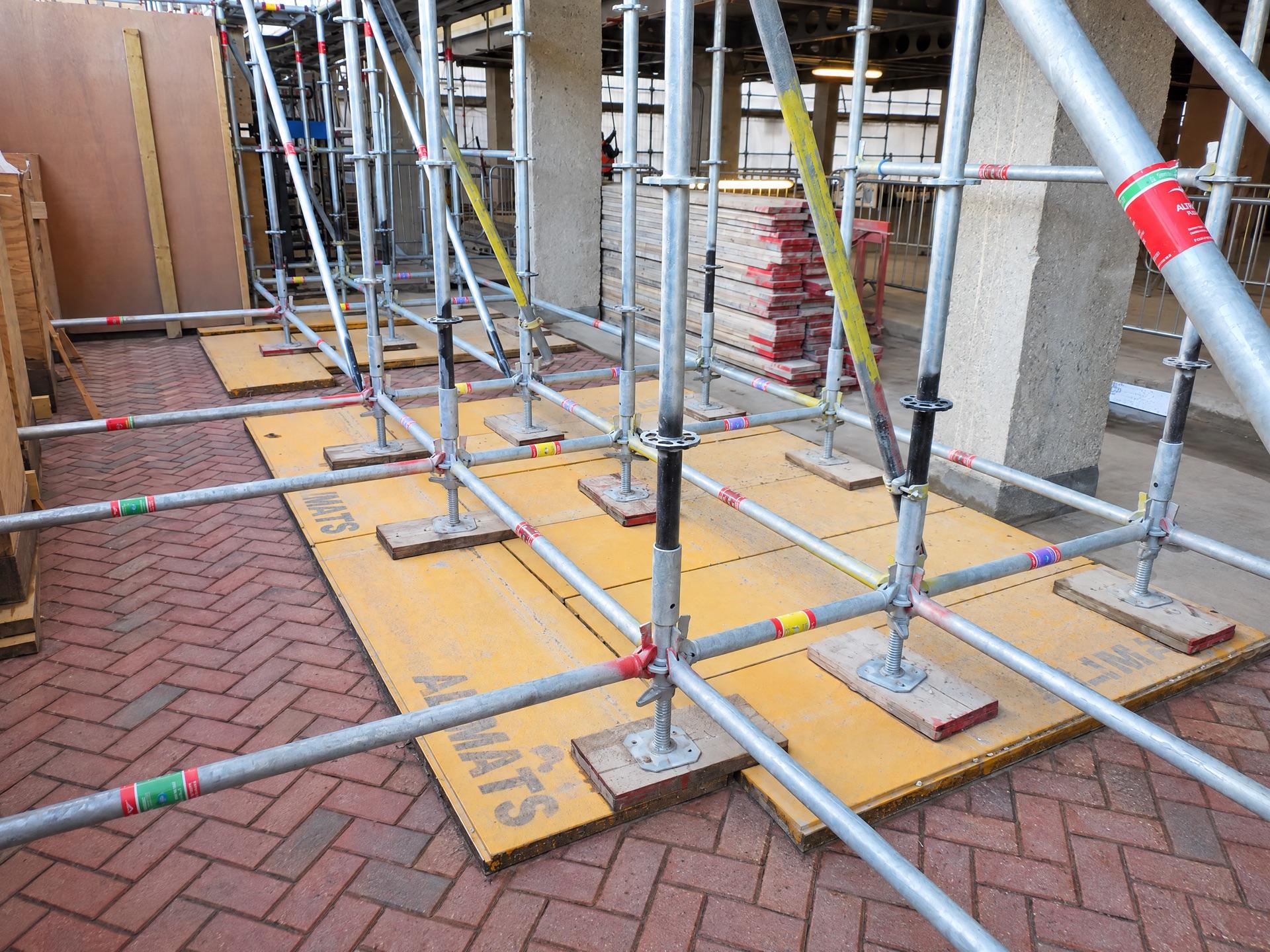
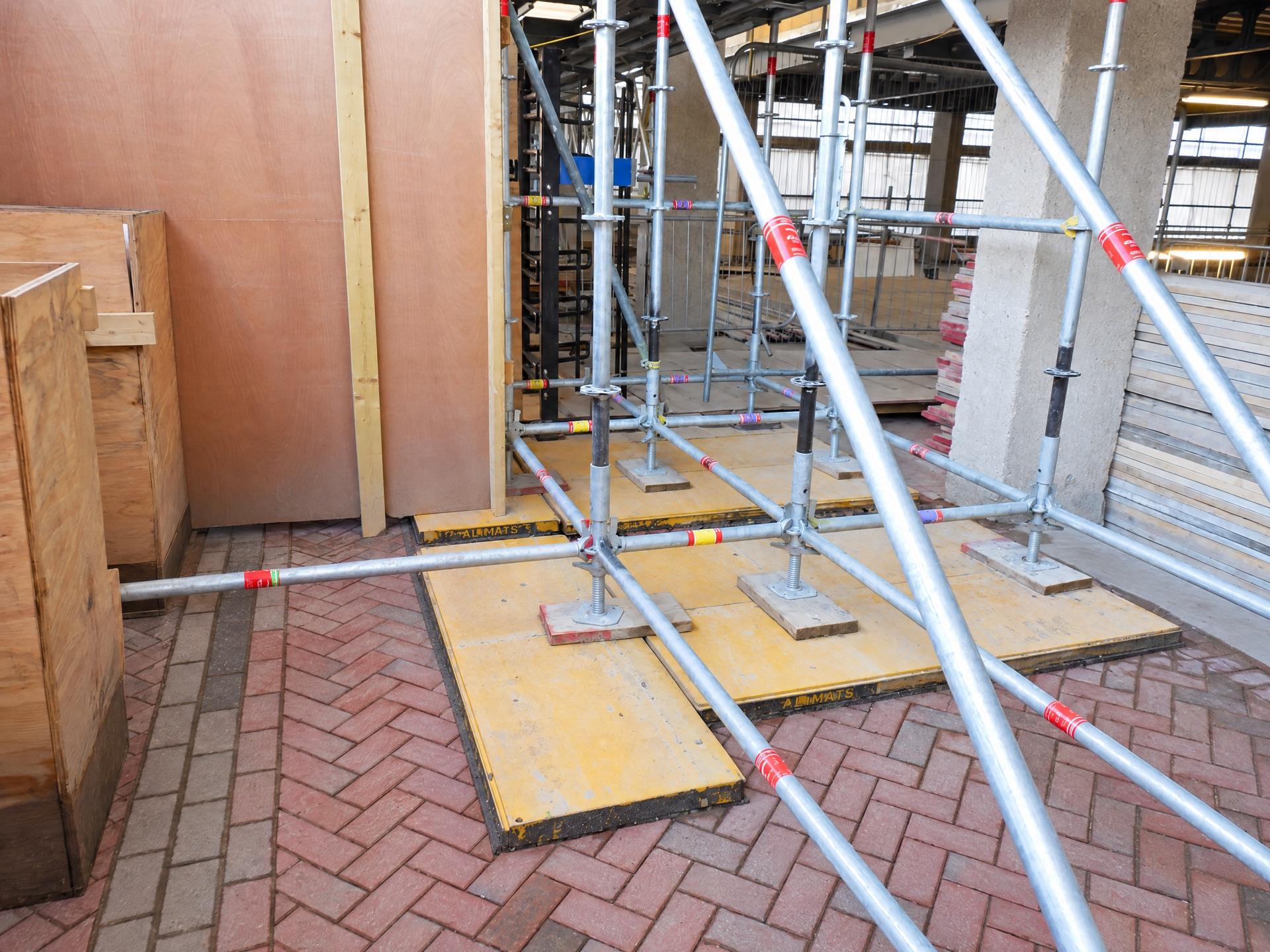
ALIMATS® are patented, interlocking aluminium load spread mats from Brilliant Ideas. Placed under scaffold bases, they spread each leg load over a larger area and reduce the pressure on the ground or structure beneath. Scaffolding is a listed application for the system, alongside crane outriggers, concrete pumps, props and powered access.
Every scaffold standard delivers its load through a small base plate. Where that pressure is more than the ground, a slab or a surface can take, the load has to be spread before it gets there. That takes a mat that is stiff as well as strong, with properties your designer can rely on.
Brings the bearing pressure down
The key function of a load spreader mat is to reduce the pressure applied to the ground. A bigger, stiffer bearing area means lower pressure under every leg.
Known properties at the time of use
ALIMATS® is a fully certified aluminium system with published section properties, so your designer can use the datasheet in their calculations.
Laid by hand
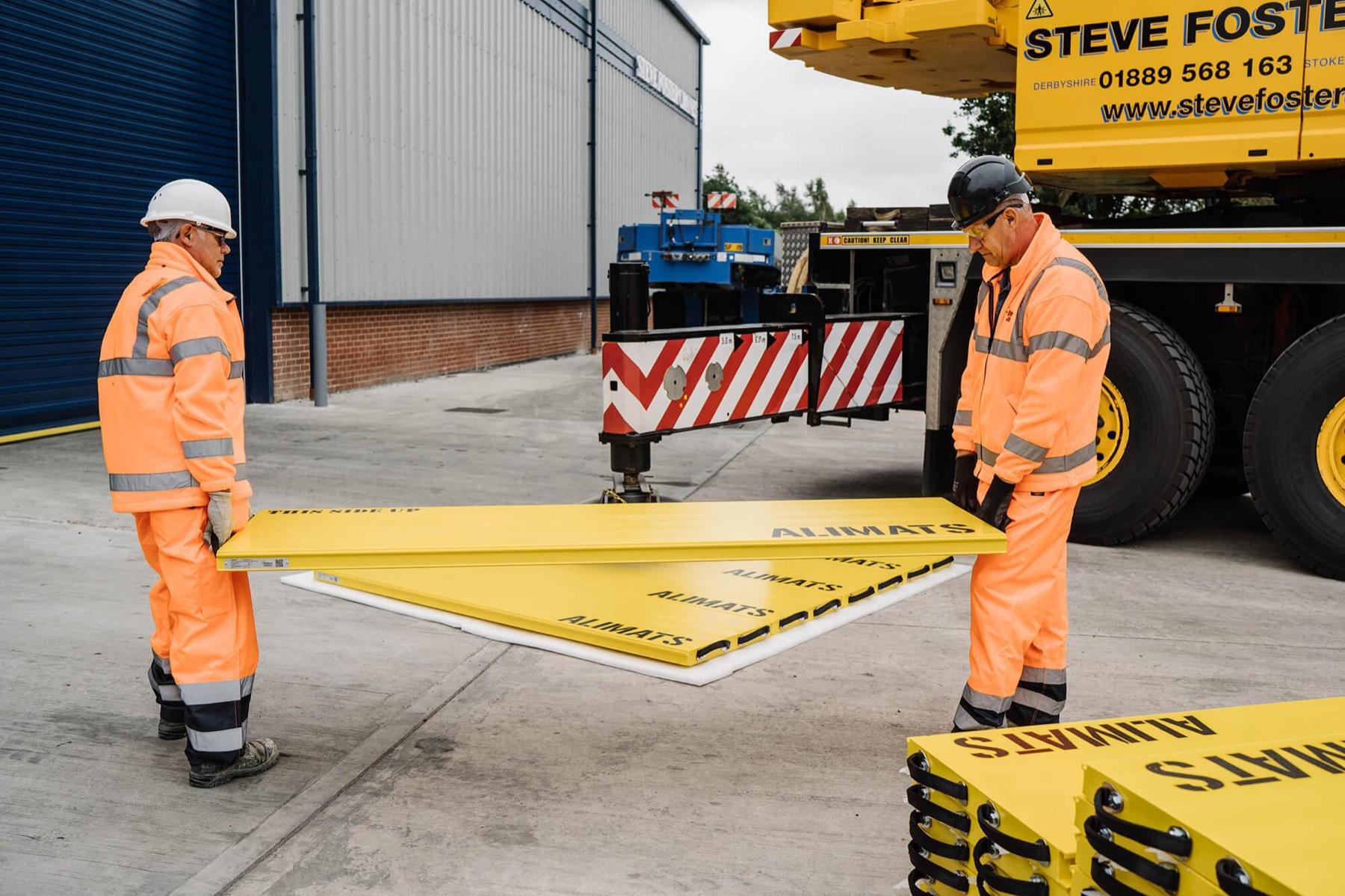
Modules weigh between 13kg and 48kg and all have handles. Two people can carry and position them, with no need for plant.

How it works
Modules interlock into one stiff mat
The interlock makes the modules act together and spreads load in both directions, giving a more even distribution to the ground than separate pieces could.
- 1
Start from the scaffold design
The leg loads, the base positions and the allowable bearing pressure set the mat size and layout. We can draw a layout for your designer to check.
- 2
Prepare the surface
The area should be level. If it is not completely level, a sand bed is advised. On hard surfaces, place a compressible layer such as Ethafoam or sand beneath the mats.
- 3
Lay and interlock
Two people lift each module and slot it into the next. The interlock must be engaged along the longitudinal joints, with no stones trapped between layers.
- 4
Bear centrally, then check
Position the base centrally on the completed mat. Once loaded, observe the mats for any sign of undue stress or settlement.
Where it earns its place
When a base plate is not enough
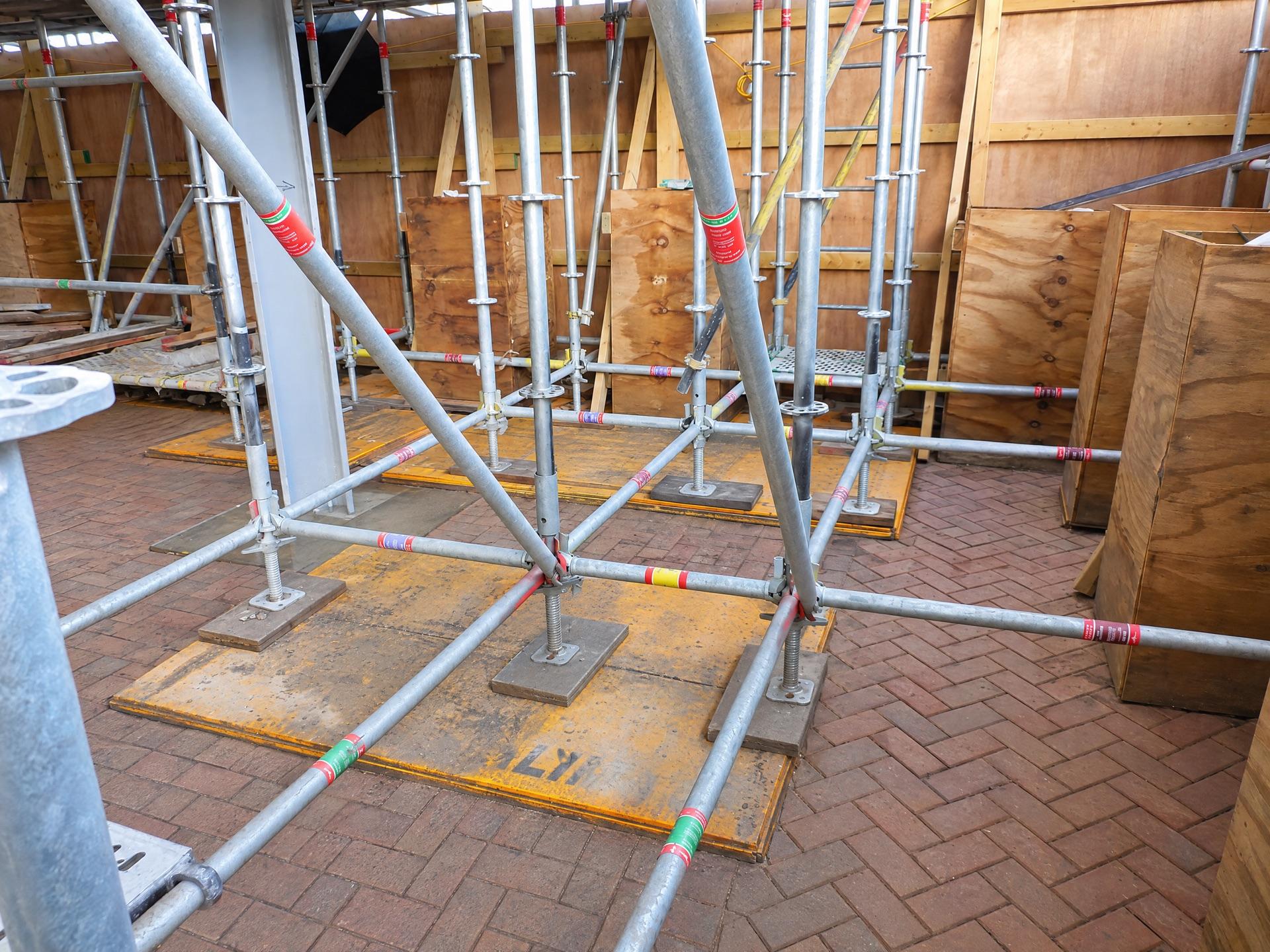
Your scaffold design decides what goes under each standard. These are the conditions where a stiff, certified load spread mat is worth specifying.
Soft or made ground
Where the allowable bearing pressure is low, a base plate alone concentrates too much load. A larger mat brings the pressure down to what the ground can take.
Tarmac, paving and concrete
A hard surface can hide a pipe network, landfill or soft ground beneath. A stiff mat on a compressible layer helps the load distribute evenly.
Suspended floors and slabs
Point loads on a suspended floor need spreading and checking against the structure. We have supplied ALIMATS® platforms on suspended floors, signed off by the client’s temporary works team.
Finished surfaces
Ethafoam sheets laid beneath the modules protect finished or delicate surfaces, and help the system work as structurally intended.
Mat size estimator
How much mat does a scaffold leg need?
Leg load divided by allowable bearing pressure gives the bearing area. Enter the two figures from your scaffold design for the nearest ALIMATS® size.
The design load on one standard, from your scaffold design.
What the ground or structure beneath can safely take.
How many standards need a mat. Optional.
A first estimate, not a design. This uses a simple approach to load spread: it assumes the load spreads evenly across the whole mat and ignores the weight of the mat. Mat size and build-up must be confirmed by your scaffold designer or temporary works engineer.
Per scaffold leg
0.8m²
bearing area needed
1.34m²
nearest ALIMATS® size
- Leg load
- 40 kN (4.08 tonnes)
- Equivalent square
- 0.89m × 0.89m
- Mat plan size
- 1.16m × 1.16m
- Pressure under the mat
- 29.7 kN/m²
- Base positions
- 12
Yellow: the suggested mat. Dashed: the area needed. Dark square: a 150mm base plate, for scale.
The module range
Five modules, every one handleable
Mat sizes are made up by interlocking modules together on site, so the layout can be adapted to the space around each base.
| Module | Dimensions | Weight |
|---|---|---|
| Mini | 580 × 580 × 60mm | 13kg |
| Short | 1160 × 580 × 60mm | 25kg |
| Standard | 1740 × 580 × 60mm | 38kg |
| Long | 2175 × 580 × 60mm | 48kg |
| Extra Long | 3480 × 290 × 60mm | 48kg |
Core mat sizes
- 0.33m²
- 1.34m²
- 2.01m²
- 2.52m²
- 3.02m²
- 3.78m²
- 4.03m²
- 5.04m²
- 6.05m²
- 7.06m²
- 8.07m²
Bespoke layouts are available where a standard size will not fit.
Aluminium, timber or plastic?
To spread a load, a mat has to be stiff
Every mat material is strong in compression. What matters is whether it can carry the load sideways across the mat before it reaches the ground. That is stiffness, shown by the modulus of elasticity.
| Property | Aluminium ALIMATS® | Timber Ekki / Azobé (D70) | Timber Oak (D40) | Plastic (UHMW) |
|---|---|---|---|---|
| Mat density (kg/m³) | 600 | 1,080 | 660 | 960 |
| Compressive strength (MPa) | 280 | 34 | 26 | 50 |
| Tensile strength (MPa) | 270 | 42 | 24 | 28 |
| Modulus of elasticity (MPa) | 69,000 | 20,000 | 13,000 | 1,350 |
Source: ALIMATS® datasheet. Download the datasheet (PDF)
Our bending test
2mm
ALIMATS® module deflection
102mm
UHMW-PE plastic mat deflection
Under a 1 tonne point load at mid span on our bending test rig, comparing a 1.74m ALIMATS® module with a 1.8m plastic mat.
Read the bending testWhat about timber?
Timber is stiffer than plastic, but its strength deteriorates with continued use and when exposed to the elements, so certification will not be available at the time of use. Aluminium is a material that can be certified after repeated use.
Hire and delivery
Delivered, supported and collected
Hire for as long as the scaffold stands
Single day, weekly and long-term hire, with an option to purchase.
Delivered by our own drivers
Nationwide delivery 24/7 on our own fleet, with timed drop-offs and collections to reduce congestion around site.
Help on site
Our drivers are CSCS card holders and carry their own PPE. If you need a hand offloading and setting up, just ask.
Inspected between hires
Every time ALIMATS® come off hire they go back to our depot to be inspected before they go out again.
Technical support included
Free technical support, bespoke layout drawings and, on more complex projects, a site visit.
Proven load spread
Specified where the structure below matters
End users and main contractors hire ALIMATS® for use under scaffolding, cranes, concrete pumps and powered access. These two projects spread loads on suspended floors.
“ALIMATS® is a great lightweight and durable product which our team could assemble and dissemble on their own.”
“The aluminium interlocking mat modules go down quickly and come out quickly – the solution worked brilliantly.”
ALIMATS® under scaffolding: your questions answered
Can’t see your question? Call the team on 01335 345111.
Can ALIMATS® be used under scaffolding?
Yes. Scaffolding is one of the listed applications for ALIMATS®, alongside crane outriggers, concrete pumps, props, MEWPs and scissor lifts, and end users and main contractors hire the system for use under scaffolding. ALIMATS® is a patented, modular aluminium load spread system: the modules interlock on site into a stiff mat that spreads the load from each base over a larger area of ground or structure.
What size of mat does a scaffold leg need?
As a first estimate, divide the leg load by the allowable bearing pressure of the ground or structure beneath it. That gives the bearing area required, and you choose the next ALIMATS® size up. Sizes run from a single 0.33m² Mini module to 8.07m². The estimator on this page does the sum for you. It is a simple approach to load spread, so the final size and build-up must be confirmed by your scaffold designer or temporary works engineer.
Does ALIMATS® replace timber sole boards?
That is a decision for your scaffold design. ALIMATS® is an engineered load spread product with published section properties, so a scaffold designer or temporary works engineer can use the datasheet in their calculations wherever the bearing pressure under a base needs to be reduced. We do not design scaffolds, but we do provide technical support and layout drawings for the mats.
Why aluminium rather than timber or plastic?
To spread a load, a mat has to be stiff, not just strong in compression. The aluminium used in ALIMATS® has a modulus of elasticity of 69,000 MPa, against 13,000 to 20,000 MPa for timber and 1,350 MPa for UHMW plastic. It is also certified: timber strength deteriorates with continued use and exposure to the elements, so its properties are not known at the time of use.
How heavy are the modules?
ALIMATS® modules weigh between 13kg and 48kg and every module is fitted with handles as standard. Two people can carry and position them by hand, so there is no need for plant, and the whole range can be delivered on a small van.
Do I need anything under the mats?
On hard surfaces we recommend a compressible layer, such as Ethafoam or sand, beneath the mats so the system works as structurally intended. If the ground is not completely level, a sand bed is advised to give a more even load distribution. Ethafoam sheets can be hired with the mats.
How long can I hire ALIMATS® for?
ALIMATS® is available for single day, weekly and long-term hire, with an option to purchase. Scaffolds often stand for months, so tell us the programme and we will quote for the full period.
Can you help with the layout?
Yes. We offer free technical support, produce bespoke layout drawings, and are happy to visit site on more complex projects. Send us the leg loads, the base positions and what the scaffold is standing on, and we will propose a mat layout for your designer to check.
Hire ALIMATS® for your scaffold
Send us the loads and we’ll propose a layout
Tell us the leg loads, the base positions and what the scaffold is standing on. We will come back with a mat layout and a hire price for your designer to check.
Prefer to talk it through?
01335 345111Request a scaffold load spread quote
Fields marked * are required. Share what you know; we can work out the rest together.