
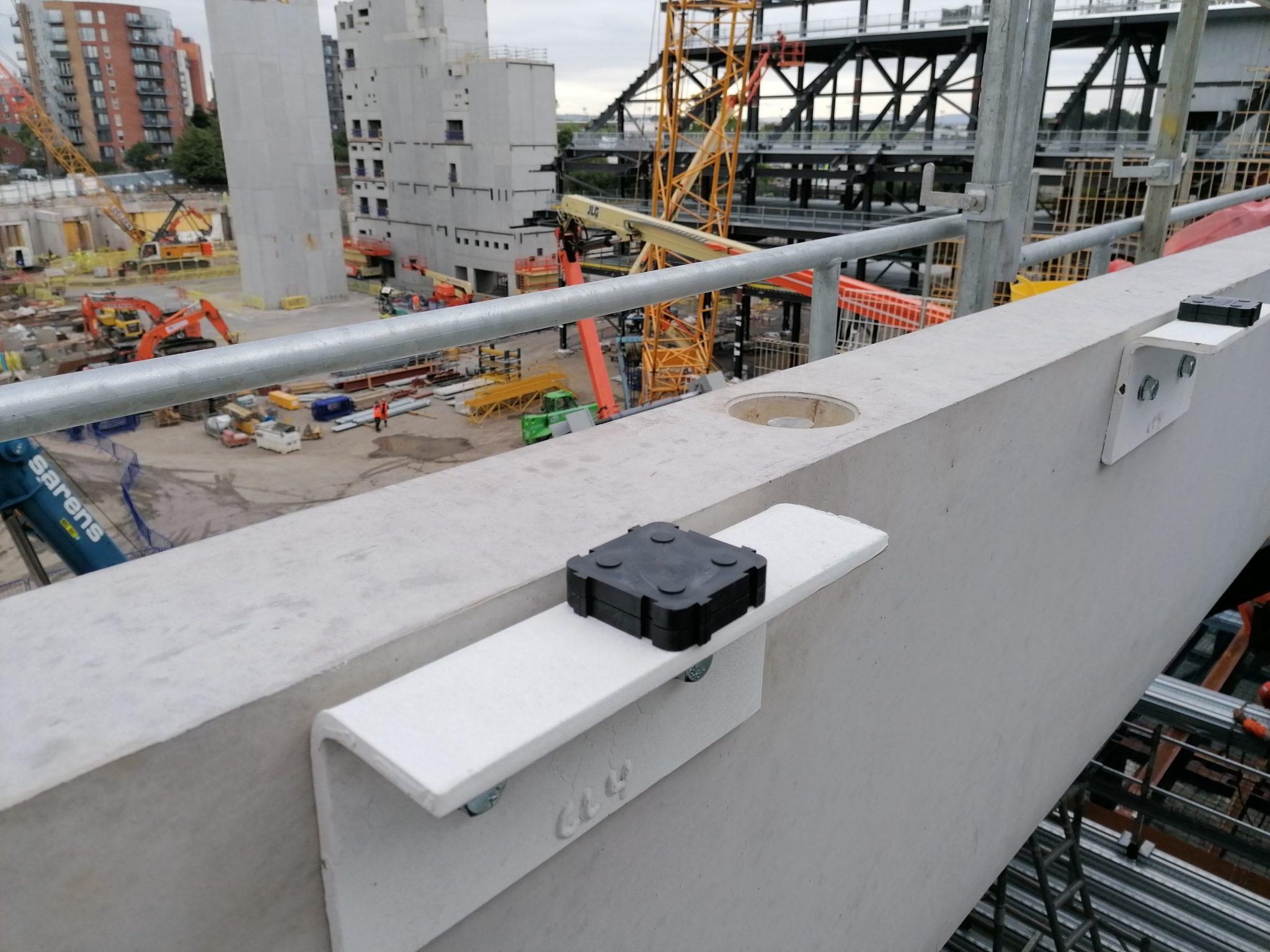
Nobody budgets time for packing out a gap. It turns up on site as an afterthought — the precast unit lands a few millimetres proud of its bearing, the steel baseplate rocks on a foundation that wasn't quite flat when it was poured, the machinery base sits with a sliver of daylight under one corner. Someone reaches for whatever's nearest, and the job moves on. But at a load-bearing interface, that gap isn't a cosmetic problem to be tidied up before the client walks the site — it's a load path, and whatever goes into it becomes part of the structure whether it was designed to be or not.
We see the consequences of getting this wrong more often than we'd like. If the material packed into that gap doesn't hold its shape under sustained load, one of two things happens. Either the load never spreads across the full bearing area and instead concentrates on whatever high spots happen to be in contact — which was never what the connection was designed for — or the packing itself slowly crushes or creeps, the gap reopens over months or years, and the load path shifts again, quietly, long after everyone involved in the original fix has left site. No structural engineer would sign either off if they saw it coming. The trouble is, it rarely gets specified at all — it gets sorted.
That's what makes levelling shims an odd category to talk about. They're rarely on the drawing at the design stage, and rarely discussed once the structure is up and performing. They sit in the gap between design and construction — the point where an idealised, perfectly flat connection meets the reality of a precast unit that's a shade out of true, or a foundation that was never going to be poured to the nearest fraction of a millimetre. Someone still has to close that gap, and what they close it with matters for as long as the structure stands.
Why whatever's to hand won't do
There's nothing wrong with a timber offcut, a folded strip of plastic packing or a wedge of card for the jobs they're actually suited to — levelling a door frame, packing a non-structural fixture, taking up play in something that isn't carrying load. They're cheap, they're already on every site, and for those jobs they work fine.
But none of them were engineered to sit permanently inside a structural connection. Timber compresses, and with moisture cycling it can rot or swell unevenly. Plastic packing strips creep under sustained compressive load — they deform slowly over time even at stresses well below the point they'd visibly fail a quick test. Card is card. This isn't a criticism of the materials; it's simply that they were never meant to be part of a load-bearing joint, and using them there is a mismatch between what the material is and what the job is now asking of it.
A structural interface deserves a product made for the job. It's the same logic we apply to ground protection — a crane doesn't get set up on whatever happens to be flat and lying around a site; it gets set up on matting engineered to spread and carry that specific load. A levelling gap is no different. If the connection matters enough to be designed, the packing that sits inside it should be engineered too, not chosen by what's within arm's reach when the problem is noticed.
What Stacker Packers actually are
Stacker Packers are our structural levelling shim — a packing product we designed specifically to fill precise gaps at load-bearing interfaces without crushing or creeping under sustained load, which is the exact failure mode that rules out timber, plastic strip and card for this kind of work.
They're used across a genuinely wide range of structural interfaces: under precast concrete units where a panel or plank needs to sit level and fully supported on its bearing; under steelwork baseplates where a column or beam end needs packing out to a true, even bearing on its foundation; behind curtain walling where panels need levelling and support at their fixing points; under machinery bases where equipment needs a stable, load-bearing footing; and at bridge bearings, where getting the gap right is central to how load transfers from deck to substructure.
What ties those applications together isn't the industry — precast, steel erection, façade fixing, plant installation and bridgeworks are otherwise unrelated trades — it's the nature of the gap itself. In every case there's a small, precise space that has to be filled with something that will still be doing its job, unchanged, in ten or twenty years' time, because nobody is coming back to repack it once the structure above is finished and loaded.
We're also clear about what Stacker Packers are not. They're not a grout, and they're not a substitute for correcting a genuinely out-of-tolerance foundation or frame — where the scale of the problem calls for remedial work, that's what should happen. They're a purpose-made way of taking up the smaller, routine variation that turns up on almost every job: the gap that's too significant to ignore and too small to justify recasting or re-fabricating whatever sits above it. That's a deliberately narrow niche, and it's the one we built them for.
The engineering principle: contact area you can actually trust
Most structural connections are designed on an assumption of full, even bearing across the intended contact area — a baseplate is sized, and its foundation prepared, on the basis that the whole underside of that plate will be in contact and sharing the load. It's a reasonable assumption to design to. It's also one that a badly packed or unpacked gap quietly breaks.
If a plate rocks on three high spots instead of sitting flush, the contact area actually carrying load can be a fraction of the area the design assumed. The visible footprint of a connection and the area genuinely transferring force through it aren't automatically the same thing — and the gap between the two is exactly where a levelling shim earns its place. Not as packing to make something look level, but as the material that makes the designed bearing area and the actual bearing area the same thing again. Clean load transfer depends on it.
That's why dimensional consistency matters here as much as raw strength. A shim engineered to a known, repeatable thickness lets an erection team build up to the correct gap predictably, stack by stack, rather than trial-fitting an assortment of offcuts until it looks about right.
It's a subtler failure mode than most people picture when they imagine a structural connection going wrong, because nothing obviously breaks. There's no crack, no bang, no sudden movement — just a joint quietly carrying its load differently to how it was calculated, potentially for years, because the gap beneath it was closed with something that couldn't hold a shape under pressure. That's precisely why the packing material at that interface deserves the same attention as the connection design itself, rather than being treated as an afterthought once the design is already signed off.
Proof at scale: La Sagrada Família
It's one thing to describe what a product is for; it's another to point at a real building where it's been used at volume. Almost 1,000,000 Stacker Packers have gone into the ongoing construction of La Sagrada Família in Barcelona — one of the most geometrically demanding and closely scrutinised construction projects anywhere in the world.
That kind of volume tells you something a single test certificate can't. This is a product that has been specified and reordered, again and again, on a project with essentially no tolerance for getting a load-bearing interface wrong. On a building where every stone is set to Gaudí's geometry and every bearing has to be right, our shims have been trusted to close the gaps that hold it all level — and to keep holding them.
What to look for when specifying shim material
If you're specifying or choosing packing material for a genuinely structural gap — as opposed to a cosmetic one — a few questions are worth asking before anything goes near the interface.
Does it hold its thickness under sustained load, rather than just under a momentary squeeze test? A structural connection isn't loaded for a second and then released; it's loaded for the life of the structure, and creep that only shows up after months in service is exactly the failure mode a timber offcut or plastic strip is prone to.
Is it dimensionally consistent? A shim that's reliably the thickness it claims to be means a stack adds up to the gap you calculated, rather than being built up and checked by trial and error on site — which costs time and invites exactly the kind of uneven, badly-packed gap worth avoiding in the first place.
Is it suited to the specific interface? A bearing exposed to weather and de-icing salts on a bridge is a different environment to a machinery base inside a climate-controlled plant room, and material that's fine in one setting may be the wrong call in the other.
And does the manufacturer actually stand behind the product for structural use, rather than selling a generic packer with no structural rating attached? That's the point we'd press hardest on, because it's the difference between a product that was designed for this job and one that's simply being pressed into service because it happens to be the right thickness. We compression-test Stacker Packer samples as part of our own product development, taking specimens to destruction rather than assuming how they'll behave under load — which is exactly what a genuinely structural product should be held to.
Frequently asked questions
What are levelling shims used for?
Levelling shims fill precise gaps at load-bearing interfaces so that load transfers evenly across the intended bearing area, rather than concentrating on high spots or shifting as the packing deforms. Typical locations include precast concrete bearings, steel baseplates, curtain walling fixings, machinery bases and bridge bearings.
Why can't I just use timber or plastic packing strips?
Timber and plastic packing strips are fine for non-structural jobs, but neither was engineered to resist crushing or creep under sustained structural load. Timber compresses and moves with moisture, and plastic strip tends to creep slowly over time even under everyday loads — which lets a structural gap reopen long after installation, when nobody is coming back to repack it.
What are Stacker Packers?
Stacker Packers are our structural levelling shim, designed to pack out load-bearing gaps without crushing or creeping over time. We supply them across precast concrete, structural steelwork, curtain walling, machinery installation and bridge bearing applications.
How is a structural levelling shim different from a standard packer?
A standard hardware packer is generally meant for non-load-bearing or lightly loaded jobs and typically carries no structural rating at all. A structural levelling shim is engineered to maintain its thickness under sustained load and to be dimensionally consistent, so you can specify it with confidence at a genuine load-bearing interface.
Where have Stacker Packers been used?
We've supplied Stacker Packers across a wide range of structural interfaces — precast concrete units, steel baseplates, curtain walling, machinery bases and bridge bearings. Almost 1,000,000 of them have gone into the ongoing construction of La Sagrada Família in Barcelona, a project with essentially no tolerance for getting a load-bearing interface wrong.
Does the thickness of a levelling shim matter?
Yes — dimensional consistency is one of the most practically important properties of a structural shim. A shim that's reliably the thickness it claims to be lets an erection or installation team build up a stack to the correct gap predictably, rather than trial-fitting mismatched offcuts until the gap looks roughly right.
What happens if a load-bearing gap is packed with the wrong material?
If the packing can't hold its shape under sustained load, either the load concentrates unevenly on whatever high spots remain in contact, or the packing itself crushes or creeps and the gap reopens. Both change the load path from what the connection was designed for — often long after the work has been signed off, and with nothing that obviously breaks to warn you.
Are levelling shims only used in precast concrete?
No. Precast concrete bearings are a common application, but structural levelling shims are also used under steel baseplates, behind curtain walling, under machinery bases and at bridge bearings — anywhere a precise, load-bearing gap needs to be packed reliably.
Should weather or chemical exposure affect the choice of shim material?
Yes. An interface exposed to weather, moisture cycling or de-icing salts — a bridge bearing, say — sits in a very different environment to an internal machinery base in a controlled plant room, and the right material for one isn't automatically right for the other. It's worth checking suitability for the specific exposure before you specify, and we're happy to advise.
How do I get technical guidance on specifying Stacker Packers for a project?
Every structural interface is slightly different, so the most reliable route is to talk to us directly with the application, the gap dimensions and the environment involved, and we'll advise the right shim configuration on a project-by-project basis.