
Why a Safe Working Load rating isn't the whole story
A manufacturer's Safe Working Load figure tells you one thing — the load at which a mat is expected to fail. It tells you nothing about what the mat does at every load below that point, which is where mats spend their entire working life. What we care about, and what a specifier should care about, is how much a mat bends under load. Deflection is the property that actually decides whether a mat is doing its job — spreading a concentrated point load from a crane outrigger or a mobile access platform leg evenly across the ground beneath it, so the bearing pressure someone calculated on paper still holds true on site.
This is not a distinction we invented to sell aluminium. The October 2014 industry design guide Construction Ground Condition for Plant makes the separation formal — strength is the load a material resists before it breaks or yields; stiffness is the load it resists before it noticeably deforms. A mat can be strong and nowhere near stiff enough: it won't crack, won't snap, comfortably clears its rated tonnage, and still bends heavily under that same load. Those are two different engineering questions — and a headline SWL figure only ever answers one of them.
So we built a rig to put a number on the second question, rather than trade descriptions of relative stiffness. We ran an ALIMATS aluminium mat against a competing UHMW-PE plastic mat at three test loads and recorded exactly how far each one deflected. What follows is the full data — the rig, the loads, and every reading.
Inside the test rig
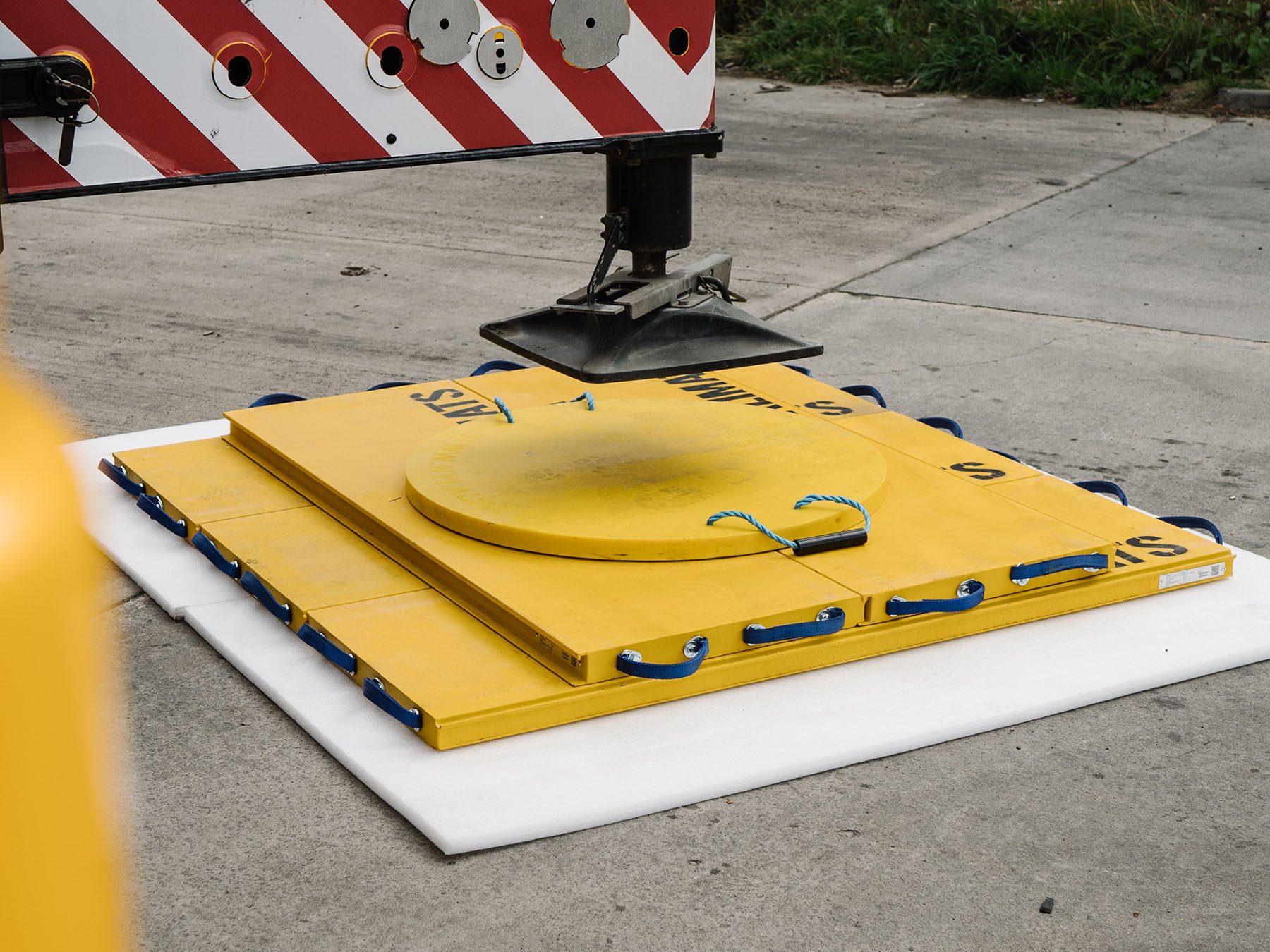
The rig applies a 3-point load through a 500mm x 500mm steel plate, 30mm deep. We chose that plate size deliberately — it simulates the ground-bearing footprint of a mobile crane outrigger foot, so we're loading the mat the way a real job does: not a broad load spread evenly across the whole panel, but the small, hard, concentrated contact patch a mat actually meets on site. That's the honest test of a crane mat — can it take a load applied over roughly a quarter of a square metre in its centre and spread that load sideways, so the ground under its full footprint shares the burden, or does it simply bend around the load like a diving board?
We ran three progressively higher loads through that same plate — 1 tonne, 2.25 tonnes and 3.5 tonnes. At each load we tested an ALIMATS aluminium mat and a competing UHMW-PE plastic mat under identical rig conditions and measured the vertical deflection at the loaded point for each. The two products weren't identical in footprint or depth — a genuinely like-for-like panel wasn't available from the competing manufacturer — so we've recorded the exact dimensions and weight of each mat at every stage alongside its deflection figure, both in the narrative below and in the results table.
The results: three loads, two materials
Across all three loads the pattern was consistent, and stark. In Test 1 we applied 1 tonne through the steel plate onto a UHMW-PE plastic mat measuring 1.8m x 0.6m, 50mm deep, weighing 52kg and manufacturer-rated for 54 tonnes. It deflected 102mm. The ALIMATS aluminium mat we tested alongside it — 1.74m x 0.58m, 60mm deep, weighing 38kg — deflected 2mm.
In Test 2 we raised the load to 2.25 tonnes on the same single-layer mats. The UHMW-PE mat deflected 328mm — more than three times its Test 1 deflection, off little more than double the load. The ALIMATS mat deflected 3mm.
Test 3 set out to answer a fair follow-up question: would doubling the plastic mat's thickness close the gap? We stacked two of the 50mm UHMW-PE mats to 100mm overall and tested them against a single-layer 60mm ALIMATS mat at 3.5 tonnes. The doubled-thickness plastic mat deflected 161mm. The single-layer ALIMATS mat deflected 8mm.
| Test | Applied load | Mat tested | Dimensions & weight | Deflection |
|---|---|---|---|---|
Test 1 | 1 tonne | UHMW-PE plastic mat | 1.8m x 0.6m x 50mm deep, 52kg, manufacturer-rated 54 tonnes | 102mm |
Test 1 | 1 tonne | ALIMATS aluminium | 1.74m x 0.58m x 60mm deep, 38kg | 2mm |
Test 2 | 2.25 tonnes | UHMW-PE plastic mat | Same single-layer mat as Test 1 | 328mm |
Test 2 | 2.25 tonnes | ALIMATS aluminium | Same single-layer mat as Test 1 | 3mm |
Test 3 | 3.5 tonnes | UHMW-PE plastic mat (double layer) | Two 50mm mats stacked, 100mm overall | 161mm |
Test 3 | 3.5 tonnes | ALIMATS aluminium (single layer) | 60mm deep | 8mm |
Test:
Applied load:
Mat tested:
Dimensions & weight:
Deflection:
Test:
Applied load:
Mat tested:
Dimensions & weight:
Deflection:
Test:
Applied load:
Mat tested:
Dimensions & weight:
Deflection:
Test:
Applied load:
Mat tested:
Dimensions & weight:
Deflection:
Test:
Applied load:
Mat tested:
Dimensions & weight:
Deflection:
Test:
Applied load:
Mat tested:
Dimensions & weight:
Deflection:
What the numbers actually mean: load triangulation
We'll be fair to the plastic mat. It's rated for 54 tonnes, and at no point across these three loads — every one a small fraction of that rating — did it crack, split or show any sign of structural failure. Compressively, it held up exactly as its manufacturer's rating says it should. This test isn't evidence that the mat is unsafe, or that its SWL rating is false. It demonstrates a different property altogether — stiffness, not strength — and the two are not the same thing.
This is where load triangulation matters. A mat that stays rigid under a point load transmits that load down through its full footprint at a shallow, even spread — the ground under the whole mat shares the pressure, which is the entire point of specifying a mat in the first place. A mat that deflects heavily stops doing that. Instead of a flat panel in full contact with the ground, it becomes a shallow bowl, bending hardest directly beneath the load and bearing less and less toward its edges. The load path narrows — it triangulates — down through a cone of material far closer in width to the loaded plate than to the mat's stated footprint.
Put a number on it. The UHMW-PE mat has a footprint of 1.08 square metres (1.8m x 0.6m); the steel plate applying the load covers 0.25 square metres (500mm x 500mm). At 102mm of deflection, the ground isn't experiencing anything like the pressure you'd calculate by dividing the load across that full 1.08 square metres — it's experiencing something much closer to the bare outrigger foot pressing almost straight into the ground, exactly the concentrated point loading the mat was specified to prevent. That gap between the footprint printed on the spec sheet and the footprint actually doing the work is the on-site consequence of low stiffness — and it's precisely what a headline SWL rating cannot show you.
What's underneath the mat matters
There's one more thing worth being straight about, and it cuts against the plastic mat, not in its favour. Bending test rigs — ours included — are typically set up with a compressible layer beneath the test mat, commonly a foam such as Ethafoam, rather than a fully rigid steel or concrete base. That's partly practical: it protects the rig and the mat, and it isolates the reading to the mat's own deflection rather than transmitting shock through into the rig frame. But it has a real effect on the numbers.
On a compressible base, some of a flexible mat's apparent give is shared between the mat bending and the foam compressing beneath it — the yielding base takes up stress that, on a genuinely rigid subgrade, would have nowhere to go except into further bending of the mat itself. So a compressible test base flatters a flexible mat's real-world deflection, because the base is doing some of the absorbing work the mat would otherwise have to do alone.
Which means the 102mm, 328mm and 161mm figures recorded on our own rig, if anything, understate how much that mat would flex on a fully rigid subgrade. It's also why we'd tell anyone comparing published deflection or SWL data between suppliers to ask one blunt question first — what surface was your test rig sitting on? Two mats tested on two different bases are not being compared like for like, however close their headline numbers look on a data sheet.
What this means for a specifier
The practical takeaway is simple — don't accept a headline SWL figure on its own when you're comparing crane mats. Ask for deflection data at stated test loads to sit alongside it, and ask what surface that data was gathered on, for the reasons set out above. Two mats can carry an identical rated tonnage on paper and spread that load nothing like equally in practice — and spreading the load, not merely surviving it, is the entire reason you specify a mat in the first place.
ALIMATS is our patented modular aluminium crane mat system, built from 6005A alloy, with SWL ratings up to 80 tonnes across the range, independently verified with input from a Fellow of the Institution of Structural Engineers and comfortably rated for use under cranes up to 150 tonnes. We hire and sell it across the UK with 24/7 delivery from our base in Little Eaton, Derbyshire — and the deflection data in this test is exactly the kind of evidence we'd tell you to ask any supplier for, ourselves included.
Frequently asked questions
Does this test mean the UHMW-PE plastic mat is unsafe or wrongly rated?
No. At no point during any of the three loads did the plastic mat crack, split or show any sign of structural failure, and every load sat well within its manufacturer's 54-tonne rating. We measured stiffness — how much the mat bends — not compressive strength, and the mat's rating concerns the latter. A mat can be strong and comfortably rated and still flex heavily under load, which is exactly what our deflection figures show.
What does "load triangulation" mean in practice?
When a mat deflects under a point load, it stops transmitting that load evenly across its full footprint and bends into a shallow bowl, concentrating the load in a narrower cone directly beneath the loaded point. The more it deflects, the closer the effective ground pressure gets to the bare outrigger foot itself, rather than the load spread across the mat's stated dimensions — which undermines the reason you specified the mat in the first place.
Why did the plastic mat's deflection get proportionally worse as the load increased?
Deflection in a flexible material doesn't usually rise in a straight line with load — it can worsen disproportionately once the material is working well within its elastic bending range but far from its compressive limit. Going from 1 tonne to 2.25 tonnes, roughly 2.25 times the load, took the plastic mat from 102mm to 328mm — more than three times the deflection. A mat can be nowhere near failing and still get markedly worse at spreading load as pressure builds.
Doubling the plastic mat's thickness only roughly halved its deflection — why not more?
Stacking two 50mm UHMW-PE mats to 100mm overall, tested at 3.5 tonnes, brought deflection down to 161mm from the 328mm we recorded on a single layer at a lower 2.25-tonne load — but that's still a fraction of the stiffness aluminium delivers at a fraction of the thickness. Doubling a flexible material's depth doesn't proportionally fix a fundamentally low-stiffness material; it mitigates it, and adds weight and layers to do so.
Why does the base the mat is tested on matter?
Bending test rigs, ours included, are commonly set up with a compressible layer such as Ethafoam beneath the test mat rather than a fully rigid base. Some of a flexible mat's deflection under load is shared with that layer giving way beneath it, which can make the mat's real-world stiffness look better than it would on a genuinely rigid subgrade. It's a good reason to ask any supplier what surface their published deflection or SWL data was tested on before you compare figures directly.
Is aluminium always stiffer than every plastic and timber alternative?
For load-spread stiffness the general hierarchy runs steel, then aluminium, then timber, then nylon, then polyethylene — so yes, aluminium out-performs timber, nylon and polyethylene on resistance to deflection. Compressive strength follows a slightly different order — steel, aluminium, nylon, polyethylene, timber — which is why a strength certificate alone won't tell you how stiff a material actually is under a point load.
How does ALIMATS achieve such low deflection at a lighter weight than the plastic mat tested?
The ALIMATS mat we tested weighed 38kg against the plastic mat's 52kg, yet deflected a fraction as much at every load. That comes down to material choice rather than sheer bulk: 6005A aluminium alloy has a far higher stiffness-to-weight ratio than UHMW-PE, so a thinner, lighter aluminium panel resists bending more effectively than a thicker, heavier plastic one.
What should I ask a mat supplier before specifying based on their SWL rating alone?
Ask for deflection data at realistic test loads, not just a maximum SWL figure, and ask what test rig and base surface that data was recorded on. A mat's SWL tells you the load it can survive; deflection data tells you whether it's actually spreading that load across its stated footprint the way your ground-bearing pressure calculation assumes it will.
What ground conditions does this test simulate?
We chose the 500mm x 500mm, 30mm-deep steel plate to represent the ground-bearing contact patch of a mobile crane outrigger foot — a small, concentrated point load rather than an evenly distributed one. That's a realistic picture of how a crane mat is actually loaded on site, where the force goes through the outrigger foot, not the whole mat surface.