
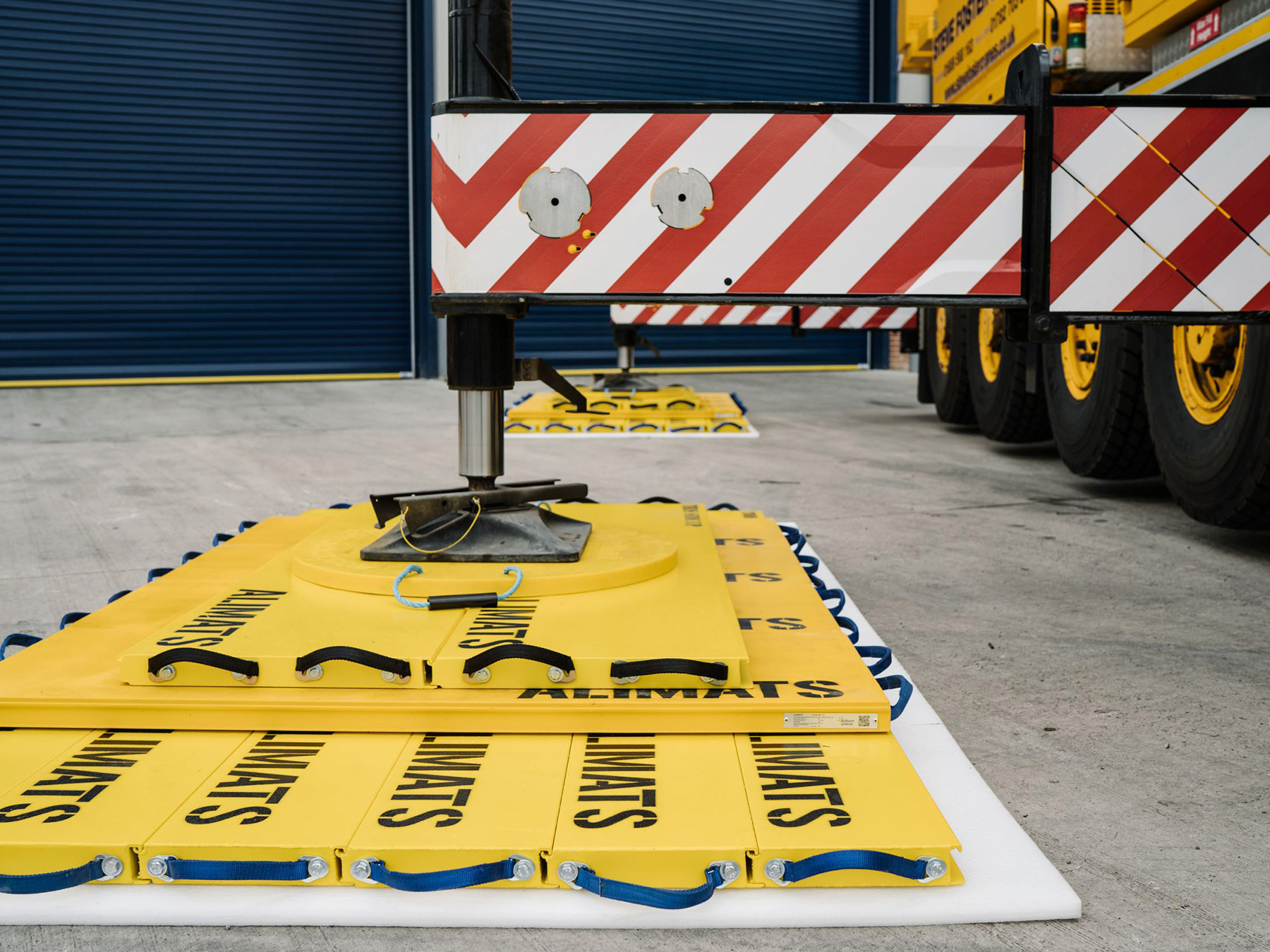
Long before anyone engineered an aluminium profile for crane matting, contractors were laying baulks of dense hardwood under outriggers and tracked plant — and in timber yards and plant hire depots across the country, they still are. Crane mats cut from Ekki, also sold as Azobe, remain one of the most widely hired pieces of trackway in the UK. It's a West African hardwood chosen over home-grown softwood or oak precisely because it's denser and stronger. Lower-grade oak baulks turn up too, usually on lighter-duty work where the extra cost of Ekki isn't justified. Neither has been pushed off site by the arrival of modular aluminium systems, and we think it's worth explaining why rather than just noting that it happened.
We make ALIMATS®, a patented modular aluminium crane mat system, so it would be easy for us to wave timber away and jump straight to our own figures. We won't, because timber has real structural reasons to still be on site — reasons that have nothing to do with strength — alongside real limitations a specifier ought to understand in plain terms. Both parts matter, and getting the specification right matters to us more than talking every job onto our own product.
Strength and stiffness, side by side
Start with what isn't in dispute. Ekki, or Azobe, is the hardwood specifiers reach for because it comfortably outperforms ordinary structural timber. Our own materials-comparison testing puts it at 34MPa compressive strength, 42MPa tensile strength, a modulus of elasticity of 20,000MPa and a density of 1,080kg/m³. Set that against the lower-grade oak sometimes used for lighter duty — 26MPa compressive, 24MPa tensile, a modulus of 13,000MPa and a density of 660kg/m³ — and the gap is obvious. Ekki is meaningfully stronger and around 1.5 times stiffer than oak, which is exactly why it's the species you specify when the load matters.
Set against aluminium, though, even Ekki is a different order of material. We engineer ALIMATS from 6005A aluminium alloy, with a compressive strength of 280MPa and a tensile strength of 270MPa — roughly eight times Ekki's figures in both directions — and a modulus of elasticity of approximately 69,000MPa, well over three times Ekki's 20,000MPa. That modulus figure is the one that matters most under a crane's outrigger, because it describes how much a material deflects under a given load — and a timber baulk will flex noticeably more than an aluminium mat carrying the same weight. Ekki is the right hardwood for the job among timbers. It still isn't in aluminium's league.
| Property | Ekki/Azobe Timber (D70) | Oak Timber (D40) | ALIMATS Aluminium (6005A) |
|---|---|---|---|
Compressive strength | 34MPa | 26MPa | 280MPa |
Tensile strength | 42MPa | 24MPa | 270MPa |
Modulus of elasticity | 20,000MPa | 13,000MPa | ~69,000MPa |
Material density | 1,080kg/m3 | 660kg/m3 | 2,700kg/m3 |
Property:
Ekki/Azobe Timber (D70):
Oak Timber (D40):
ALIMATS Aluminium (6005A):
Property:
Ekki/Azobe Timber (D70):
Oak Timber (D40):
ALIMATS Aluminium (6005A):
Property:
Ekki/Azobe Timber (D70):
Oak Timber (D40):
ALIMATS Aluminium (6005A):
Property:
Ekki/Azobe Timber (D70):
Oak Timber (D40):
ALIMATS Aluminium (6005A):
Where timber genuinely earns its keep
None of that settles the question, because strength and stiffness aren't the only things you're buying. The clearest case for timber is cost and availability — baulks are, generally speaking, the cheapest matting going, whether bought or hired, and they're stocked by ordinary timber merchants and plant hire firms right across the UK rather than sourced through a specialist manufacturing supply chain. For a genuinely short or one-off job — a single lift, a weekend's access track, a budget that simply doesn't stretch to a modular system — that isn't a minor point in timber's favour, it's often the deciding one.
The second is non-conductivity, and it's a real, specific advantage rather than a fallback argument. Timber doesn't conduct electricity, unlike aluminium or steel, which matters directly on work near live electrical apparatus or anywhere a non-conductive working surface is a stated requirement. That's a genuine niche where timber isn't the compromise — it's the safer choice, and sometimes the only one that satisfies the spec at all.
Then there's familiarity and disposability, which sound like soft points but aren't. Every groundworker and site manager already reads timber intuitively — how it behaves, how it's checked, how it's stacked — with none of the handling knowledge a patented interlocking system asks new users to learn. And at end of life, a worn-out or damaged baulk can simply be disposed of, or burned as waste timber, without any special process. That's genuinely simpler than the end-of-life path for a metal system, even one built to be inspected and redeployed rather than scrapped.
Finally, timber can be site-cut and adapted with basic tools if an odd size crops up — a saw and a tape measure will get a baulk to the length a job needs. A modular aluminium mat like ours can't be treated the same way. Cut a module down and its rating goes with it, because the geometry and the independently verified load figures apply to the module as we engineer it, not to whatever's left once someone's taken a grinder to it.
Handling: heavy is heavy, whatever it's made from
One limitation timber shares with steel rather than aluminium is sheer bulk. A baulk built to a size that actually matters under real crane loads is heavy, and moving it — especially once it's soaked up ground moisture and got heavier still — generally means plant, not two people with a lifting strap. That's a cost and a scheduling dependency that has to be weighed against the up-front cheapness of the material, particularly on a programme where mats need repositioning more than once.
We engineered ALIMATS around the opposite trade-off: modules from 13kg up to 48kg, built into configurations from 1.34m² to 8.07m², all handleable by two people with no heavy plant needed. That doesn't make timber the wrong choice for a job that only ever needs moving once — but on a programme where mats shift regularly, the plant booking that timber and steel both tend to require is a recurring cost worth costing properly rather than assuming away.
Which to choose, and when
Reduced to something usable on site, the choice turns on duration, budget and what's actually driving the requirement. Timber makes its strongest case on short or one-off jobs where cost is the binding constraint, on any work involving live electrical apparatus or a specific need for a non-conductive surface, and for teams who want a material everyone already knows how to handle and can dispose of without a second thought when the job's done. If a baulk goes down once, for a job measured in days rather than months, timber's low up-front cost is hard to beat.
Aluminium earns its place wherever consistency and certainty matter as much as raw capability — programmes where the same rated load has to be guaranteed mat after mat, sites where mats are redeployed repeatedly and a hidden internal defect simply isn't an acceptable risk, and anywhere the absence of a telehandler makes a 48kg module a genuinely different proposition to a baulk that needs plant to shift. We rate ALIMATS to safe working loads up to 80 tonnes, independently verified with a Fellow of the Institution of Structural Engineers, we supply it on hire or purchase with 24/7 UK delivery, and we inspect, clean and check every mat before it goes out again — precisely the kind of certainty a natural material can't offer in the same way. Neither material is wrong. They're solving for different things, and the specifier who can say which is which is doing the job properly.
Frequently asked questions
Is Ekki really stronger than other timber used for crane mats?
Yes. Ekki, or Azobe, is chosen for crane matting because it outperforms lower-grade timbers like oak on every relevant measure. Our testing puts Ekki at 34MPa compressive strength and a 20,000MPa modulus of elasticity, against oak's 26MPa and 13,000MPa, which is why oak baulks tend to be reserved for lighter-duty work.
Is timber cheaper than aluminium crane mats?
Generally, yes. Timber baulks are typically the cheapest matting to buy or hire, and you'll find them at ordinary timber merchants and plant hire firms nationwide rather than through a specialist manufacturing supply chain. That makes timber a sensible choice for short or one-off jobs where budget is the main driver.
Why would I choose timber over aluminium for electrical work?
Because timber doesn't conduct electricity, unlike aluminium or steel. On work near live electrical apparatus, or wherever a non-conductive surface is specifically required, that's a genuine safety advantage rather than a compromise — sometimes it's the only material that satisfies the spec at all.
How do I know if a timber crane mat has lost strength?
That's the hard part. Internal splits, checking or rot can develop without showing on the surface, so a baulk that looks sound on inspection may already have lost some of its rated capacity. Aluminium has no direct equivalent to that risk, because damage to a solid extrusion — bending or cracking — is generally visible where it happened.
Can timber crane mats be cut to size on site?
Yes, with basic tools — a saw and a tape measure will adapt a baulk to an odd length. That's much harder with a modular aluminium system, because cutting a module down voids its independently verified load rating; the figures apply to the module as engineered, not to what's left after it's been cut.
How much weaker is oak than Ekki for crane matting?
Noticeably weaker across the board. Oak's compressive strength (26MPa) and tensile strength (24MPa) both trail Ekki's (34MPa and 42MPa), and its 13,000MPa modulus of elasticity is around a third lower than Ekki's 20,000MPa. That's why we'd point you to Ekki when the load genuinely matters, with oak reserved for lighter duty.
What happens to timber crane mats at the end of their working life?
A worn-out or damaged baulk can simply be disposed of, or burned as waste timber, with no special recycling process — genuinely simpler in that respect than a patented metal system. The trade-off is that a timber baulk tends to reach that point sooner, and with less certainty about how much capacity it lost along the way.
Do timber crane mats need plant to move them?
Large baulks heavy enough to matter under real crane loads generally do, much as steel mats do — and a baulk that's absorbed ground moisture over a job will be heavier again. That's a real, recurring cost on any programme where mats need repositioning more than once. Our ALIMATS modules run from 13kg to 48kg and move with two people, no heavy plant needed.
Which lasts longer on site, timber or aluminium?
Aluminium's engineered properties stay consistent over time, whereas timber's strength shifts with moisture content and age, and can be quietly reduced by internal splitting or rot you can't see from outside. We also inspect, clean and check every ALIMATS mat before it goes out again, which gives a level of ongoing certainty a natural material can't fully match.