
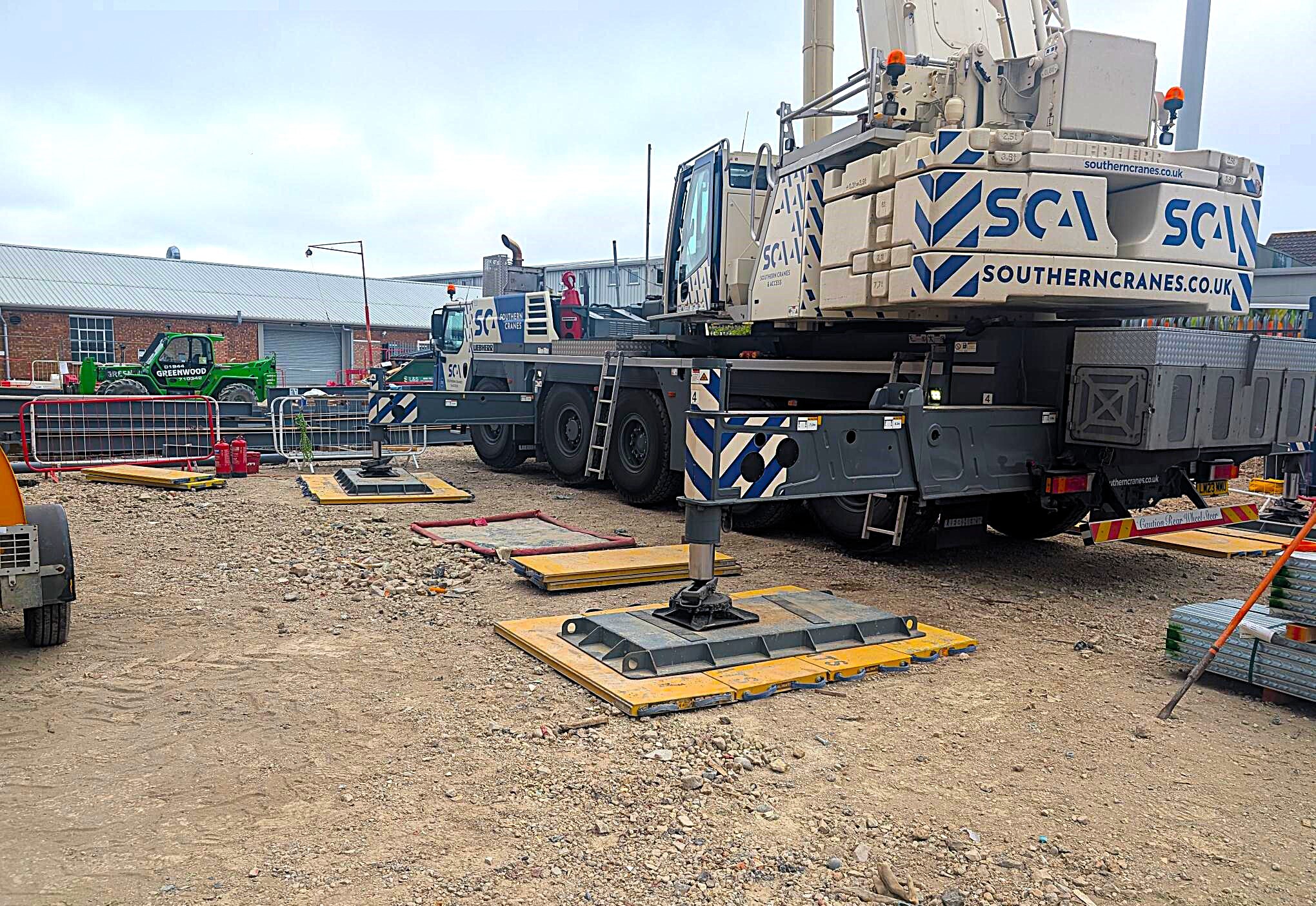
Both materials are on UK sites right now, doing the same basic job — spreading crane and vehicle loads over ground that can't take them directly — and neither has driven the other off. In an industry this cost-conscious, that tells you something. If one material were simply better in every respect, the other would have disappeared from site compounds years ago. It hasn't, and the reason is that aluminium and steel crane mats solve genuinely different problems, so the right choice depends far more on the job in front of you than on which material a supplier happens to sell.
We make ALIMATS®, our own range of aluminium crane mats, so we'll start with the part that cuts against us: steel is the stronger and stiffer of the two materials, by any measure of raw material science, and we're not going to argue that away. What matters on site is where that advantage earns its keep and where it doesn't — and once you look at the way a mat is actually used, the picture gets a lot more interesting than the raw metal properties suggest.
Strength and Stiffness: The Numbers, Straight
Steel is stiffer and stronger than aluminium alloy, section for section, by a wide margin. Steel's modulus of elasticity sits at roughly 200,000MPa; a high-strength aluminium alloy like the 6005A we use in ALIMATS comes in around 69,000MPa — call it a third of the stiffness. Its yield and tensile strengths run ahead of aluminium's too, for a given section size. Anyone claiming aluminium is "just as strong" as steel in the abstract isn't being straight with you.
What matters is what a manufacturer does with that raw material once its properties are known. We engineer ALIMATS from 6005A aluminium alloy — 280MPa compressive strength, 270MPa tensile — worked into a patented modular interlocking geometry and independently verified against real crane loads with a Fellow of the Institution of Structural Engineers. That gives safe working loads up to 80 tonnes, comfortably covering cranes up to 150 tonnes. It isn't aluminium overtaking steel's material properties — it's careful geometry and rigorous engineering making a lighter material perform to a genuinely high standard for the loads a mat actually sees. Steel mats reach their numbers a different way, through sheer section thickness and mass, and for some jobs that's exactly the right approach.
| Property | Steel | ALIMATS (Aluminium 6005A) |
|---|---|---|
Modulus of elasticity | ~200,000MPa | ~69,000MPa |
Relative stiffness | Higher, by a wide margin | Lower, offset by patented interlocking geometry |
Density | ~7,850kg/m3 | 2,700kg/m3 |
Corrosion resistance | Requires galvanising or painting, plus ongoing maintenance | Natural oxide layer, no coating required |
Typical handling | Often requires plant to lift and reposition | Handleable by two people, no plant needed |
Best suited to | Permanent installations, extreme point loads, sheltered environments | Programmes with frequent remobilisation, outdoor exposure, tight access |
Property:
Steel:
ALIMATS (Aluminium 6005A):
Property:
Steel:
ALIMATS (Aluminium 6005A):
Property:
Steel:
ALIMATS (Aluminium 6005A):
Property:
Steel:
ALIMATS (Aluminium 6005A):
Property:
Steel:
ALIMATS (Aluminium 6005A):
Property:
Steel:
ALIMATS (Aluminium 6005A):
Where Steel's Extra Strength Earns Its Keep
None of that stiffness advantage is academic. There are real jobs on real UK sites where steel is the more sensible specification, and a good specifier should be able to say why rather than defaulting to habit. The clearest case is a permanent or semi-permanent installation — a mat going down for the life of a structure, or for a multi-year programme where it will never be lifted out and redeployed. In that scenario a lighter material's transport and handling advantages count for very little, because the mat only moves once, and steel's raw stiffness under sustained, repeated loading becomes the property that matters.
The same logic holds for extremely high concentrated point loads — outriggers or crawler tracks bearing down on a small footprint at the very top end of what any trackway mat is asked to do — and for indoor or controlled environments such as a factory floor, a power station outage or a covered fabrication yard, where the mat never sees weather and corrosion simply isn't a factor. Strip out the transport penalty and the corrosion question, and steel's case is a strong one. Rule it out reflexively, purely because aluminium is the newer or more talked-about option, and you're not specifying properly.
The Handling Trade-Off: Two People vs a Machine
The other side of that stiffness advantage is mass, and mass has to go somewhere. A steel mat built to genuinely useful dimensions under real crane loads is heavy — heavy enough that it typically needs a telehandler, excavator or similar plant to lift and place it, and heavy enough that repositioning it mid-programme means booking that plant again. That's not a minor inconvenience to wave away. On a site where mats move every few days as the programme progresses, the cost of the plant and its operator, and the time lost waiting for both to be free, is a real and recurring cost — and it has to be set against steel's strength advantage, not ignored.
We engineered ALIMATS around the opposite trade-off. Individual modules run from 13kg for the Mini unit up to 48kg for the Long and Extra Long modules, building into configurations from 1.34m² to 8.07m², and every module in that range is handleable by two people with no plant needed. On a site reconfiguring a crane pad weekly, or shifting mats between several positions across a programme, that difference compounds fast — it's the gap between a five-minute job for two groundworkers and a job that needs a machine, an operator and a slot booked into the day's plan.
Corrosion and Maintenance Over the Life of a Mat
Left bare, steel rusts, and a crane mat spends its working life in exactly the conditions that bring that on fastest — wet ground, standing water, mud and repeated abrasion from tracked plant driving over it. Steel mats meant for long service are usually galvanised or painted, and that protective layer is itself a maintenance item. It gets scored and chipped by the very plant traffic the mat exists to support, and once it's breached, corrosion starts at that point regardless of what's happening elsewhere. Keeping a fleet of steel mats properly protected over years of hire or ownership means a genuine, ongoing programme, not a one-off treatment.
Aluminium's advantage here isn't a coating at all. It's a natural oxide layer that forms on the surface on exposure to air and effectively stops further oxidation — no paint, no galvanising, no applied treatment. That's a basic property of the metal, and it's why our mats don't carry the same recurring maintenance overhead. It matters for anyone hiring mats for a long programme, or buying a fleet for repeated redeployment across sites. We inspect, clean and check every ALIMATS module before it goes back out, but there's no galvanising or repainting cycle sitting behind that inspection.
Choosing Between Them: A Practical Framework
Reduced to something you can use on a Monday morning, the choice comes down to how long the mat stays put and what's driving the load. Steel earns its keep where a mat goes down once and stays down — permanent hardstanding, long-duration outage work, a semi-permanent crane pad on a multi-year build — or where the load sits right at the extreme end of concentrated point loading and the site is sheltered from the weather, inside a building or a covered yard. If the mat is handled once, by a machine already on site for other reasons, steel's cost per tonne of raw strength is competitive and its corrosion resistance is irrelevant.
Aluminium makes the stronger case wherever a mat moves — utilities and infrastructure programmes with mats shifting weekly or between sites, projects run on tight access without a telehandler permanently available, and anywhere months or years of outdoor exposure would otherwise mean a galvanising or repainting cycle. ALIMATS is built for exactly that pattern: safe working loads up to 80 tonnes covering cranes up to 150 tonnes, modules handleable by two people with no plant, and a hire or purchase model backed by 24/7 UK delivery, suited to programmes where the mat requirement changes as the job progresses. Over 80% of the UK's top twenty Tier 1 contractors now specify it — not because steel has stopped being useful, but because most live programmes move their mats often enough that the maintenance-free, plant-free case for aluminium is hard to ignore.
Frequently asked questions
Is steel really stronger than aluminium for crane mats?
Yes, and there's no getting around it — steel is stiffer and stronger than aluminium alloy by a wide margin, with a modulus of elasticity roughly three times that of the 6005A alloy we use in ALIMATS. What closes the gap in practice is geometry and engineering. A patented modular interlock and independently verified safe working loads let ALIMATS handle up to 80 tonnes despite the lighter base material.
When does steel actually make more sense than aluminium?
Mainly for permanent or semi-permanent installations where the mat goes down once and isn't moved again, for extremely high concentrated point loads, and in indoor or covered environments where corrosion resistance is irrelevant. In those situations the transport and handling penalty of steel's extra weight barely registers, so its raw strength advantage becomes the deciding factor. We'll tell you when that's the case for your site.
Do aluminium crane mats corrode like steel does?
No. Aluminium forms a natural oxide layer on exposure to air that stops further oxidation without any applied coating. Steel needs galvanising or painting to resist corrosion, and that protective layer gets chipped by plant traffic over time, opening up an ongoing maintenance cycle that aluminium mats simply don't carry.
How much does mat weight actually affect site costs?
More than it looks on paper. Lighter mats mean more trackway per lorry load, fewer deliveries and — critically — no need to book a telehandler or excavator just to move mats around site. ALIMATS modules run from 13kg to 48kg and are handleable by two people, which removes a recurring plant cost that steel mats of a comparable working size generally can't avoid.
Can ALIMATS really cope with the same loads as steel mats?
For the loads most UK crane and plant movements actually generate, yes. ALIMATS carries safe working loads up to 80 tonnes, comfortably covering cranes up to 150 tonnes, and every figure is independently verified with a Fellow of the Institution of Structural Engineers. At the very extreme end of concentrated, permanent loading, steel's raw stiffness still has the edge, and we'll say so.
Do steel crane mats always need plant to move them?
Not always, but mats built to a size that matters under real crane loads generally do, simply because of the weight steel carries at that thickness. That's a genuine practical cost — booking a telehandler and operator every time a pad needs reconfiguring — and it's the main reason sites that reposition mats frequently move to aluminium instead.
Is aluminium more expensive than steel over the life of a project?
It depends on how often the mats move and how long the programme runs. Steel can be the cheaper option for a mat laid once and left; aluminium usually wins out over a programme with several remobilisations, because savings in transport loads, handling plant and avoided maintenance stack up over time. ALIMATS is available on day, week or long-term hire as well as purchase, so it's worth costing both against the actual programme rather than the mat price alone.
Can aluminium and steel mats be used on the same site?
Yes, and it's fairly common — a permanent steel-matted crane pad alongside aluminium trackway for the access routes that get repositioned as work progresses. There's no technical reason not to mix the two where each is doing the job it's best suited to.