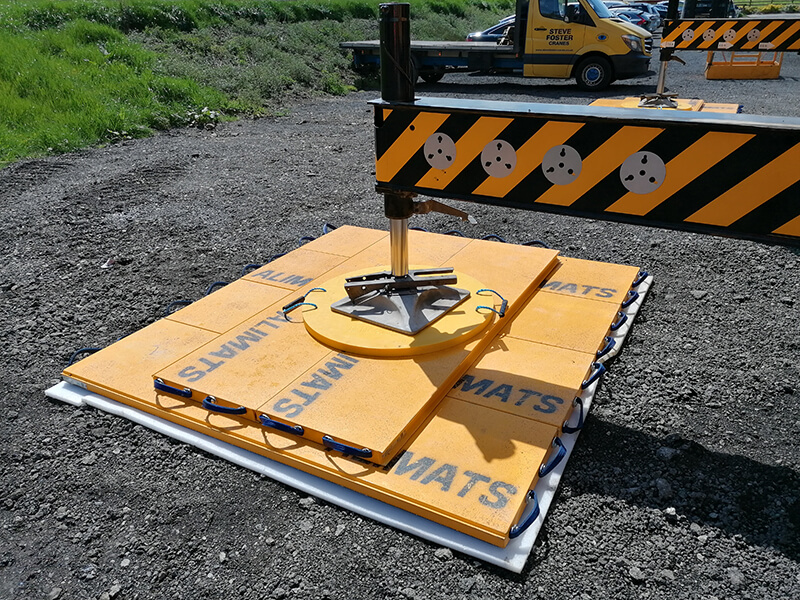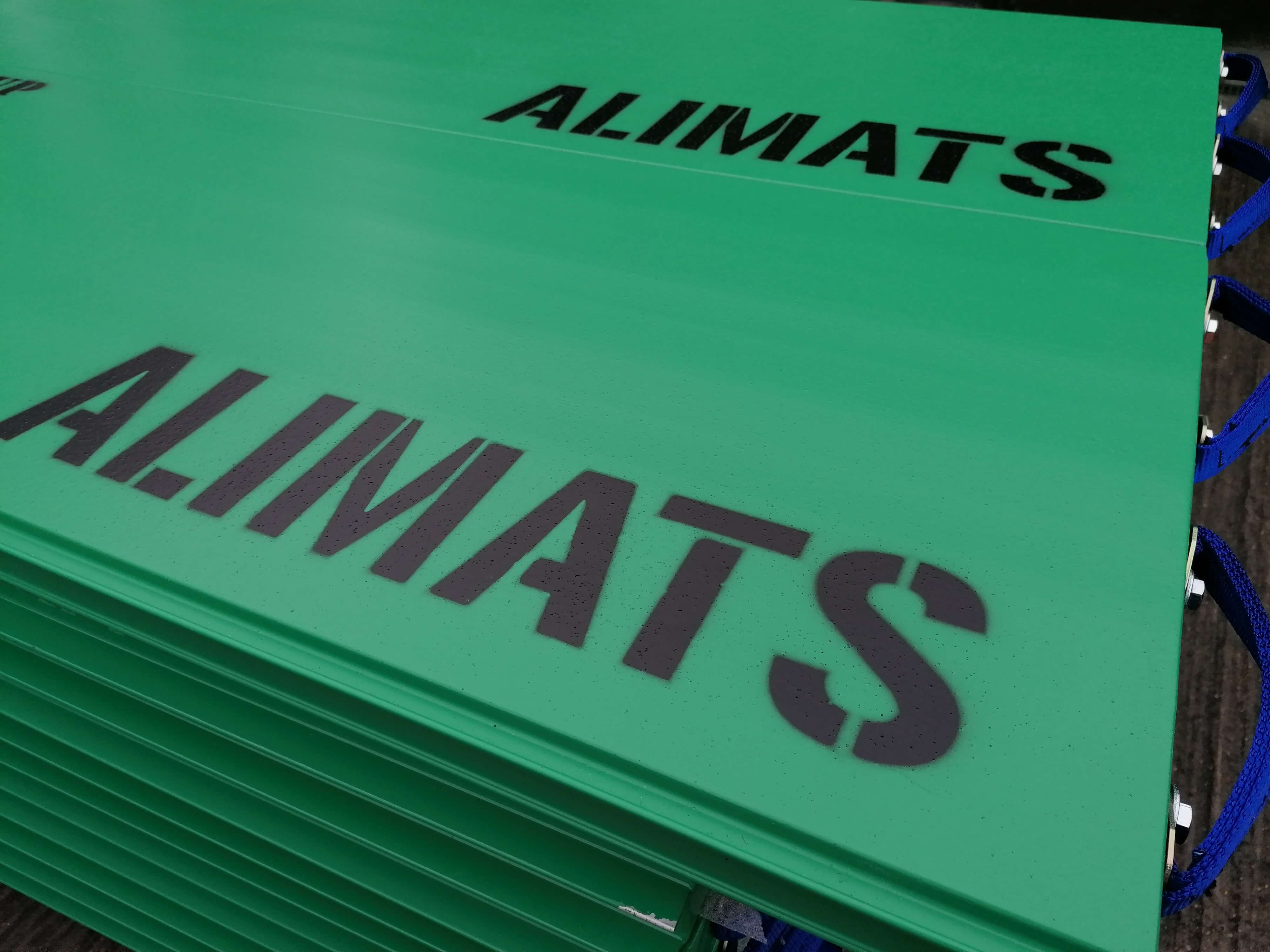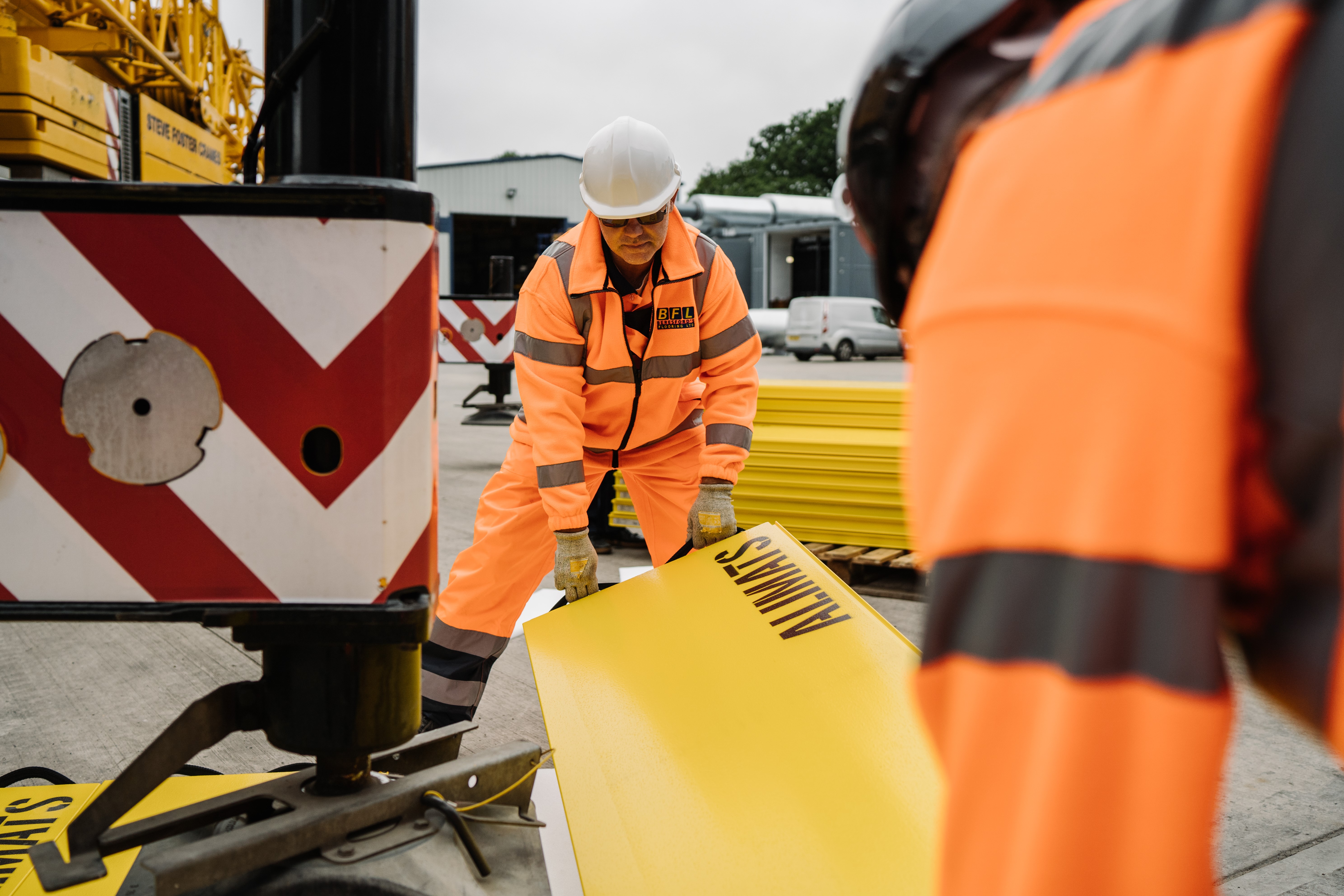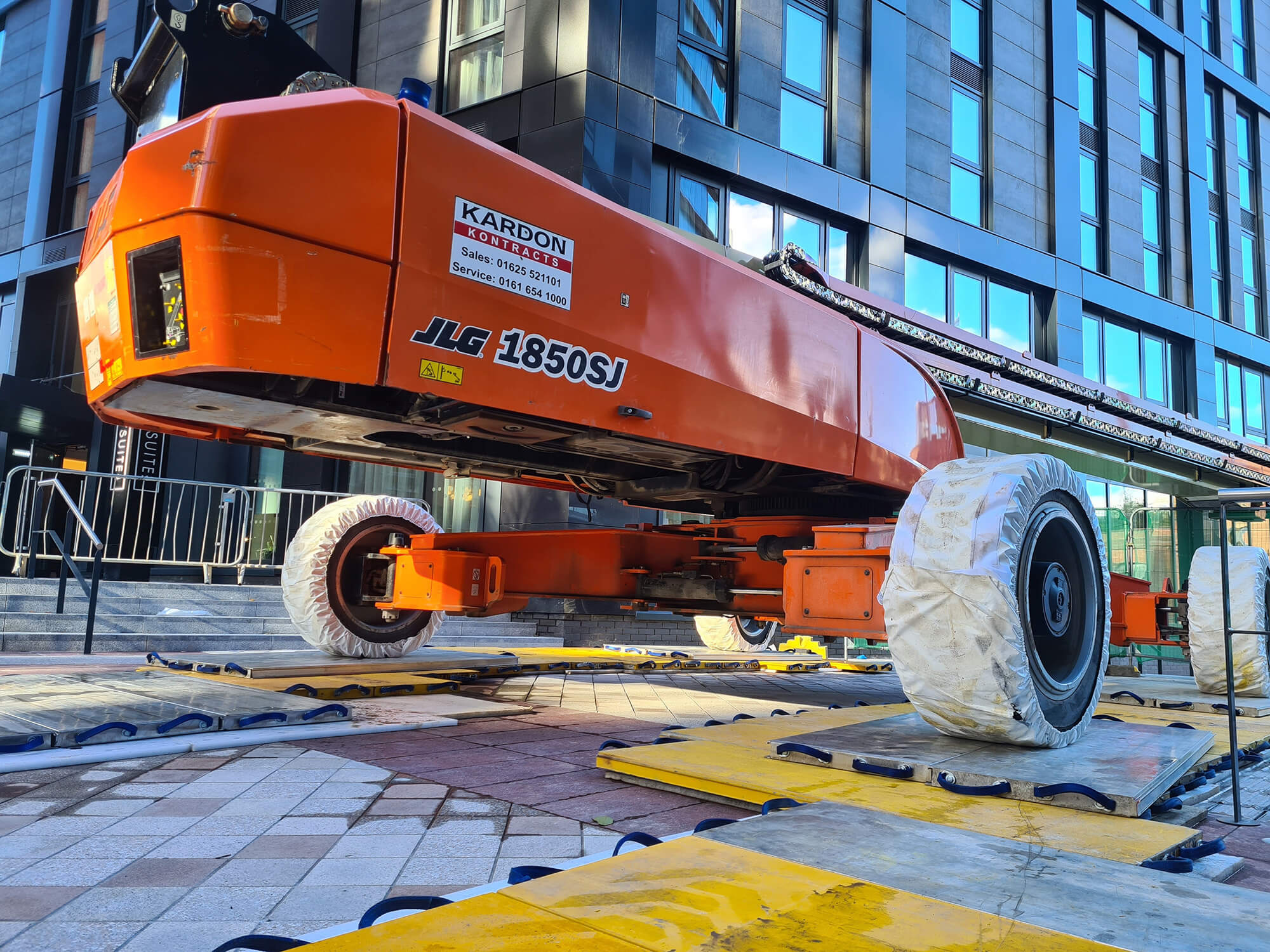
Aluminium crane mats didn't come about because someone decided aluminium sounded modern. They came about because two problems needed solving at once — ground pressure and handling. A mat that spreads load well enough to stop a 100-tonne crawler crane sinking into made-ground has to be substantial, but a substantial steel mat needs a machine to move it, and machine-handling defeats half the point of matting — which is to be laid, repositioned and lifted away by hand or with light plant, quickly, without a second crane standing by just to shift the first one's ground protection.
Aluminium is the only structural metal that gets both sides of that equation into workable numbers, and that's why we build ALIMATS® from it rather than steel or timber. Our patented modular mat system exists to do one thing well — spread heavy loads across weak ground while staying handleable — and the alloy is where that starts. Below we set out what "aluminium" actually means in a crane mat: the specific alloy we extrude, the module engineering, and the questions we'd want a specifier to ask before assuming one supplier's aluminium mat is the same product as another's.
Why 6005A, not just "aluminium"
"Aluminium" covers a wide family of alloys with very different mechanical properties, depending on what's added to the base metal and how it's processed. We make every ALIMATS module from 6005A — a certified recycled extruded aluminium alloy from the 6xxx series — because it extrudes cleanly into long structural profiles and heat-treats to a genuinely useful strength without the brittleness some higher-strength alloys bring.
The numbers behind that choice: 6005A gives a compressive strength of 280MPa, a tensile strength of 270MPa, a modulus of elasticity around 69,000MPa and a density of 2,700kg/m3. Those figures matter more as a ratio than in isolation — strength-to-weight is the number a specifier actually cares about, and it's that ratio that puts aluminium ahead of both mild steel and timber or plastic. Steel is denser, so a steel mat thick enough to match our stiffness comes out too heavy to handle; timber and plastic are light enough, but nowhere near stiff enough at a comparable thickness.
Extruding from recycled stock rather than virgin billet also keeps the alloy's properties consistent module to module — extrusion is a controlled process, so there's none of the variability you'd get from a casting. It's a practical sustainability point as well: aluminium recycles repeatedly without the base metal degrading the way some recycled materials do, which is why our recycled 6005A holds the same compressive and tensile figures as the numbers above.
The interlocking module system
The other half of what makes ALIMATS handleable — rather than just "made of a light metal" — is our patented interlocking design. Modules connect edge to edge with no bolts, no pins and no crew standing round with a torque wrench. The interlock is mechanical, built into the extrusion profile itself, so two modules lock together under load the same way whether it's a groundworker's first day on a project or their five-hundredth.
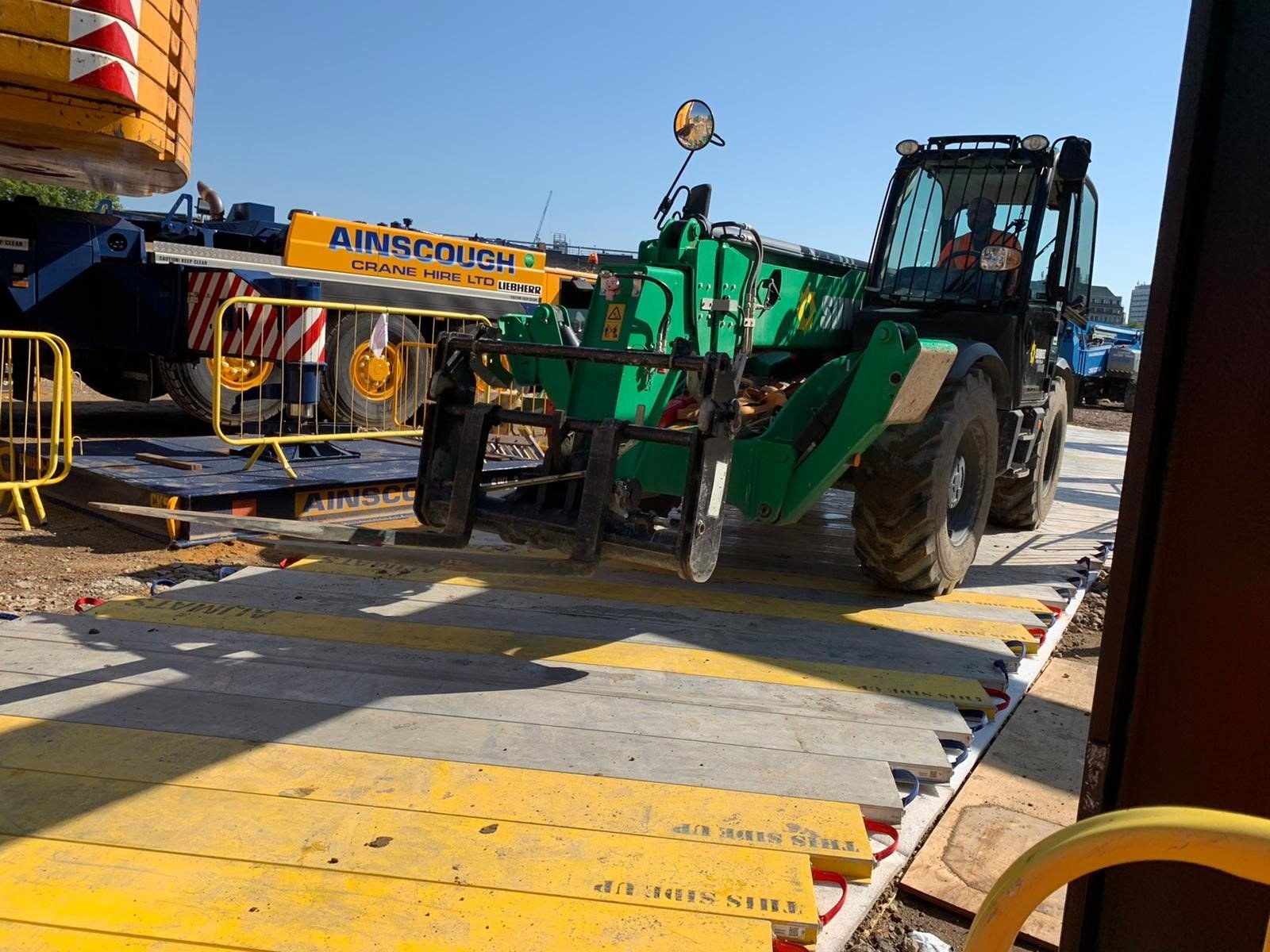
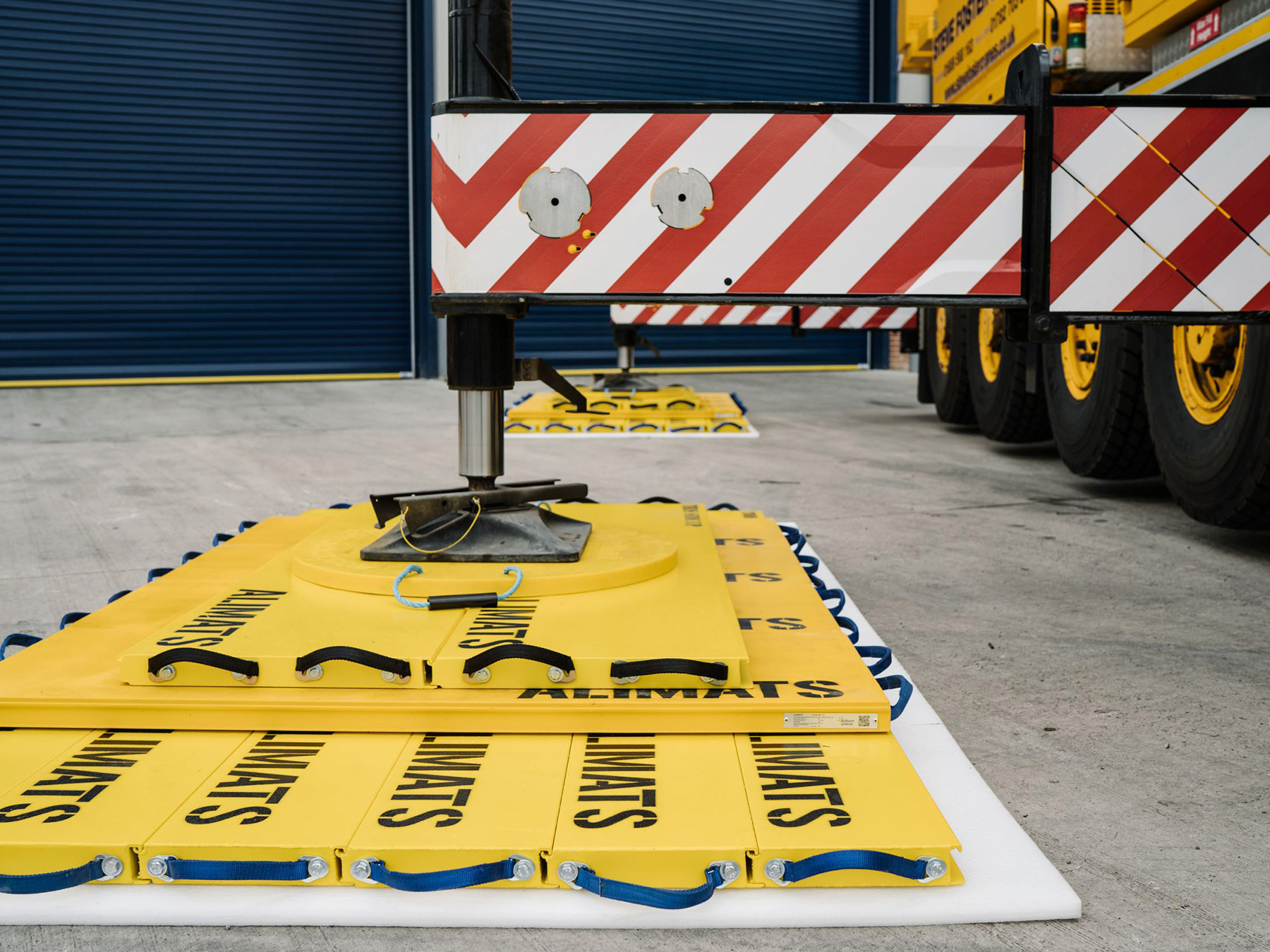
That matters on site because crane mat configurations rarely stay one shape for a whole contract — a run laid for a crawler's tracks on Monday might need reconfiguring for a mobile crane's outrigger footprint by Thursday, and the interlock is what lets a small team do that without lifting gear. Our modules combine into configurations from 1.34m2 up to 8.07m2, built from the range we set out below, so a specifier isn't stuck with whatever single mat size a supplier happens to hold in stock — the footprint gets assembled to match the actual load area, rather than the load being squeezed to match the mat.
The weight-to-stiffness trade-off
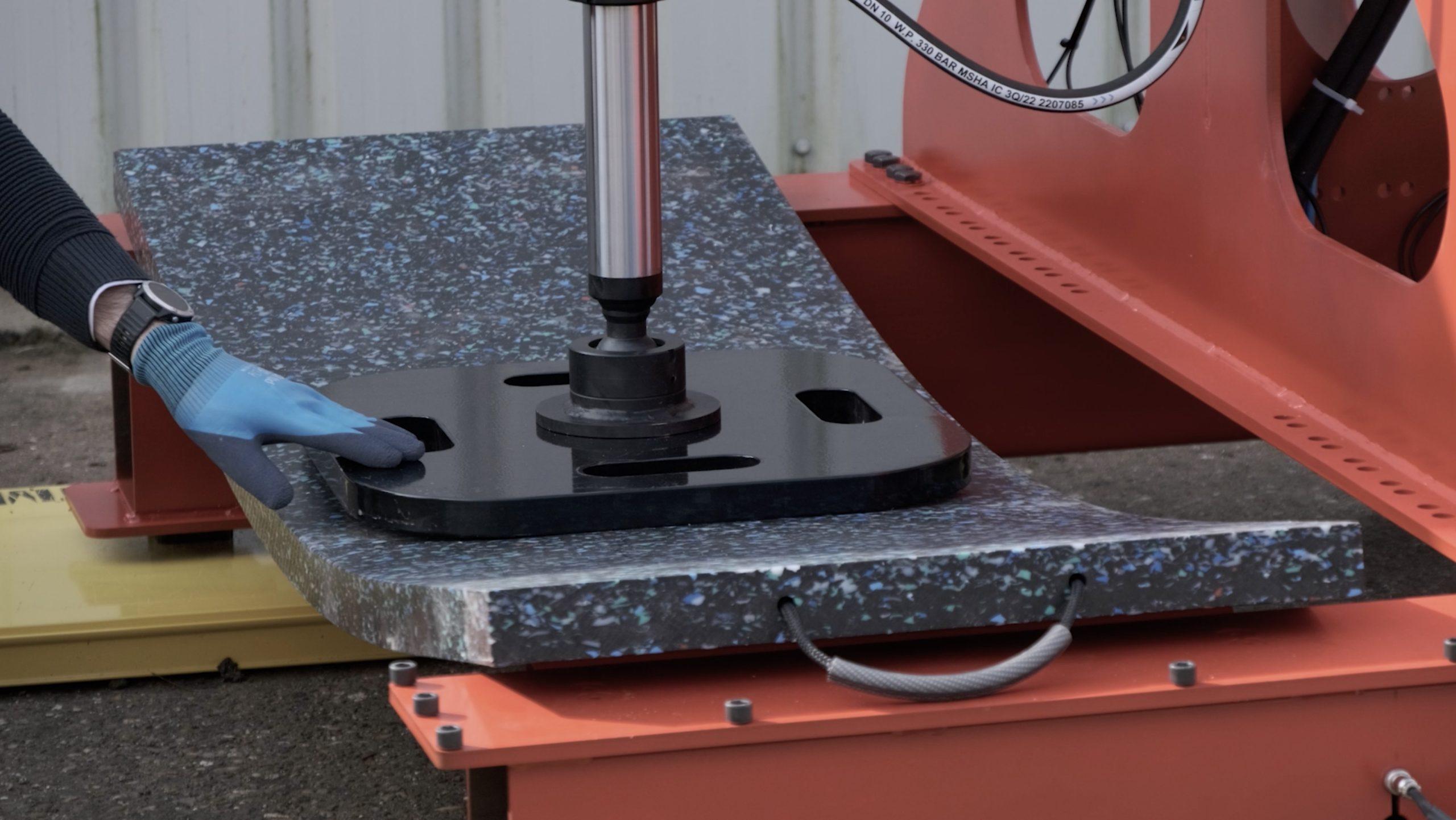
Steel is stiffer than aluminium, and we won't pretend otherwise — it's a plain materials fact. The problem is handleability. Steel dense enough to be useful under crane loads, in a size a two-person team can lift without plant, doesn't really exist; you end up needing a machine to move your ground protection, which defeats the purpose of matting. Plastic goes the other way — UHMW-PE mats are genuinely light, but they flex far more than aluminium under load.
Independent bending tests put a number on that gap: at the same test loads, ALIMATS deflected in single millimetres where a competing UHMW-PE plastic mat deflected in tens of centimetres — the full rig, loads and figures are in our aluminium vs plastic bending test. That's the case for aluminium in one paragraph — stiff enough to keep a crane's outrigger pad level and the ground pressure genuinely spread, light enough that modules still move by hand. Deflection isn't just a comfort figure, either. A mat that flexes tens of millimetres under an outrigger is a mat letting the load point tilt, which is exactly the movement a crane's stability calculations assume isn't happening underneath it.
How aluminium behaves outdoors, year after year
Ground mats live outside — in mud, standing water, de-icing salt residue and UV — for years on end, often stacked away wet straight off a site. That's a harder environment than it sounds, and it's where a lot of ground protection quietly gets worse without anyone noticing, until a mat is pulled out of storage for a job and doesn't behave the way it did when it went in.
Aluminium sidesteps most of that, and we don't have to do anything to make it happen: its corrosion resistance comes from the metal reacting with the air — a thin, stable oxide layer — not from anything sprayed or dipped on at the factory. Steel plate left in the same conditions builds up rust scale that changes its weight and surface texture over time; a steel mat that's spent a winter stacked wet doesn't handle the way it did new, and the fix is usually repainting or replacing it. Pull an ALIMATS module out of our yard after the same winter and it weighs, and behaves, much as it did going in — which matters far more for a product we expect people to move by hand than for something a machine shifts anyway.
The module range, size for size
ALIMATS come in five module sizes, combining into configurations from 1.34m2 to 8.07m2 depending on what a lift needs underneath it.
SWL across the range runs up to 80 tonnes, and our configurations sit comfortably under cranes up to 150 tonnes — covering everything from a compact mobile crane's outriggers to a large crawler's track mats. Every SWL figure across that range has been independently verified with a Fellow of the Institution of Structural Engineers, not taken on the extrusion supplier's word or modelled in-house alone. We'd say that's worth asking any supplier about specifically, because "SWL" printed on a spec sheet is only as good as whoever checked it.
| Module | Dimensions | Weight | Typical use |
|---|---|---|---|
Mini | 0.58m x 0.58m | 13kg | Tight or awkward footprints |
Short | 1160 x 580mm | 25kg | Infill and smaller configurations |
Standard | 1740 x 580mm | 38kg | General-purpose configurations |
Long | 2175 x 580mm | 48kg | Typical in ~5m2 configurations |
Extra Long | 3480 x 290mm | 48kg | Typical in 6-8m2 configurations, powered access work |
Module:
Dimensions:
Weight:
Typical use:
Module:
Dimensions:
Weight:
Typical use:
Module:
Dimensions:
Weight:
Typical use:
Module:
Dimensions:
Weight:
Typical use:
Module:
Dimensions:
Weight:
Typical use:
Hire, buy, and what happens between deployments
ALIMATS are available on single day hire, weekly hire, long-term hire or outright purchase, and we'll paint them in a contractor's corporate colours for firms that want their own branding on site rather than ours. We deliver 24/7 across the UK on our own FORS Bronze-accredited fleet, with our own drivers — most of them CPCS certified — rather than a subcontracted haulier, which matters when a mat run has to be on site ahead of a crane turning up at an odd hour.
Between hires, we inspect, clean and quality-check every mat before it's redeployed, so what turns up on the next job hasn't quietly carried hairline damage off the last one. Our system has been specified on HS2, Hinkley Point C, Heathrow and Gatwick airports, Google's King's Cross HQ, Euston Station, Grangemouth Refinery, London Bridge, Manchester's Co-op Live Arena and Scottish wind farm developments, and it's now used by more than 80% of the UK's top twenty Tier 1 contractors. Which route makes sense — day rate, weekly, long-term or purchase — usually comes down to how often you need matting rather than the size of a single job: a contractor with mats on rotation across several sites a year tends to find long-term hire or purchase cheaper over time, while a one-off lift is usually a short hire and nothing more.
What to check when you're comparing "aluminium mats"
"Aluminium crane mat" isn't a single spec, and we'd treat the phrase as a starting point for questions rather than an answer in itself. Ask what alloy is actually used — 6005A behaves very differently under load to a softer alloy that extrudes just as easily but doesn't hold the same compressive strength. Ask whether the mat is extruded or cast, because extrusion gives the consistent, controlled grain structure that casting doesn't.
Ask how the modules connect — a genuine interlocking system, patented or not, behaves differently under lateral load than mats simply butted together or bolted with separate plates. Ask who verified the SWL figures, and how, because a number with no independent check behind it is a marketing claim, not an engineering one. And ask what happens to the mats between hires — a supplier who can't describe an inspection and refurbishment process is telling you, indirectly, that the mat you get might be the one that came off a job with damage nobody looked at. None of that shows up in a photo of a mat on a pallet, which is exactly why we'd ask before one ever ends up under a crane.
Frequently asked questions
Why is aluminium used for crane mats instead of steel?
Steel is stiffer, but a steel mat sized to be genuinely useful under crane loads is too heavy to move without a machine — which defeats the point of ground protection meant to be laid and repositioned quickly. Aluminium's strength-to-weight ratio gives us the stiffness needed to spread ground pressure without the density that makes steel unmanageable at useful sizes. It's the practical middle ground between steel's rigidity and plastic's low weight, and it's why we build ALIMATS from it.
What alloy are ALIMATS made from, and does the alloy grade matter?
We make ALIMATS from 6005A, a certified recycled extruded aluminium alloy chosen for its combination of compressive strength (280MPa), tensile strength (270MPa) and a modulus of elasticity around 69,000MPa. Not all aluminium mats use the same grade — a softer alloy extrudes just as easily but won't hold the same load figures — so we'd ask any supplier about the alloy specification directly rather than assume "aluminium" means one fixed set of properties.
Do aluminium crane mats corrode or rust outdoors?
Aluminium forms a thin, stable oxide layer on contact with air, and that layer protects the metal underneath from further corrosion without paint or galvanising — so we don't apply one. It's a natural property of the metal rather than an applied coating, so it isn't lost to the scratches and abrasion of being dragged across hardstanding the way a chipped coating on steel would be.
What's the safe working load of an aluminium crane mat?
Across our range, SWL runs up to 80 tonnes, with configurations sitting comfortably under cranes up to 150 tonnes. We've had every SWL figure independently verified with a Fellow of the Institution of Structural Engineers, rather than relying on the extrusion supplier's figures alone — we'd say it's worth confirming with any supplier, because not every published SWL has had that independent check behind it.
Can aluminium crane mat modules be reconfigured on site into different sizes?
Yes — our patented interlocking design lets modules from Mini (0.58m x 0.58m) up to Extra Long (3480 x 290mm) combine into configurations from 1.34m2 up to 8.07m2. That means we build a footprint to match the actual crane or lift requirement, rather than a specifier being limited to fixed mat sizes.
Is recycled aluminium as strong as virgin aluminium for crane mats?
We use certified recycled extruded 6005A, and aluminium recycles repeatedly without the base material degrading. The extrusion process itself keeps the mechanical properties consistent module to module, so recycled stock doesn't mean any compromise on the compressive or tensile strength figures.
Should I hire or buy aluminium crane mats?
ALIMATS are available on single day, weekly or long-term hire, or for outright purchase, and we'll paint them in your corporate colours if you want your own branding on site. Which option makes sense usually depends on how often you need matting: occasional single lifts tend to suit short hire, while running mats across multiple sites through the year often makes long-term hire or purchase more cost-effective.
Are hired aluminium crane mats inspected between jobs?
Every ALIMATS module is inspected, cleaned and quality-checked before it goes back out on hire, so damage from a previous deployment doesn't quietly travel to the next site. That sits alongside 24/7 UK delivery on our own FORS Bronze-accredited fleet, so both the condition of the mats and the logistics getting them to site are handled directly rather than through a third party.