There's one fact that changes everything about ground support for a MEWP, and it has nothing to do with tonnage. When the ground gives way under a crane outrigger or a concrete pump leg, what's at risk is the machine, a driveway, a day's programme — expensive, but recoverable. When it gives way under a scissor lift or a boom lift, there is very likely somebody standing in the basket several metres up, hands full of tools, with no cab to retreat into and no way of telling from height that one corner has started to sink beneath their feet.
That is why we treat ground support for access platforms as a different job to the one we do under cranes and pumps. It isn't really about protecting the asset or the slab underneath it, although both matter — it's about keeping the machine upright and level while there's a person on it who can't feel the ground moving.
A fall-from-height risk, not a plant-damage risk
IPAF — the International Powered Access Federation — publishes extensive guidance on ground conditions for exactly this reason, and checking the ground before raising a platform is standard content on IPAF operator training rather than something left to a plant manager's risk assessment back in the office. That distinction matters. A crane outrigger settling a few millimetres over a shift is something a slewing operator or a banksman on the ground can catch and correct. A MEWP operator who has already raised the platform gets no such warning — by the time a stabiliser has lost contact, or a scissor lift's chassis has tilted past its limit, the person who needed to know has been up in the air for however long the job has taken.
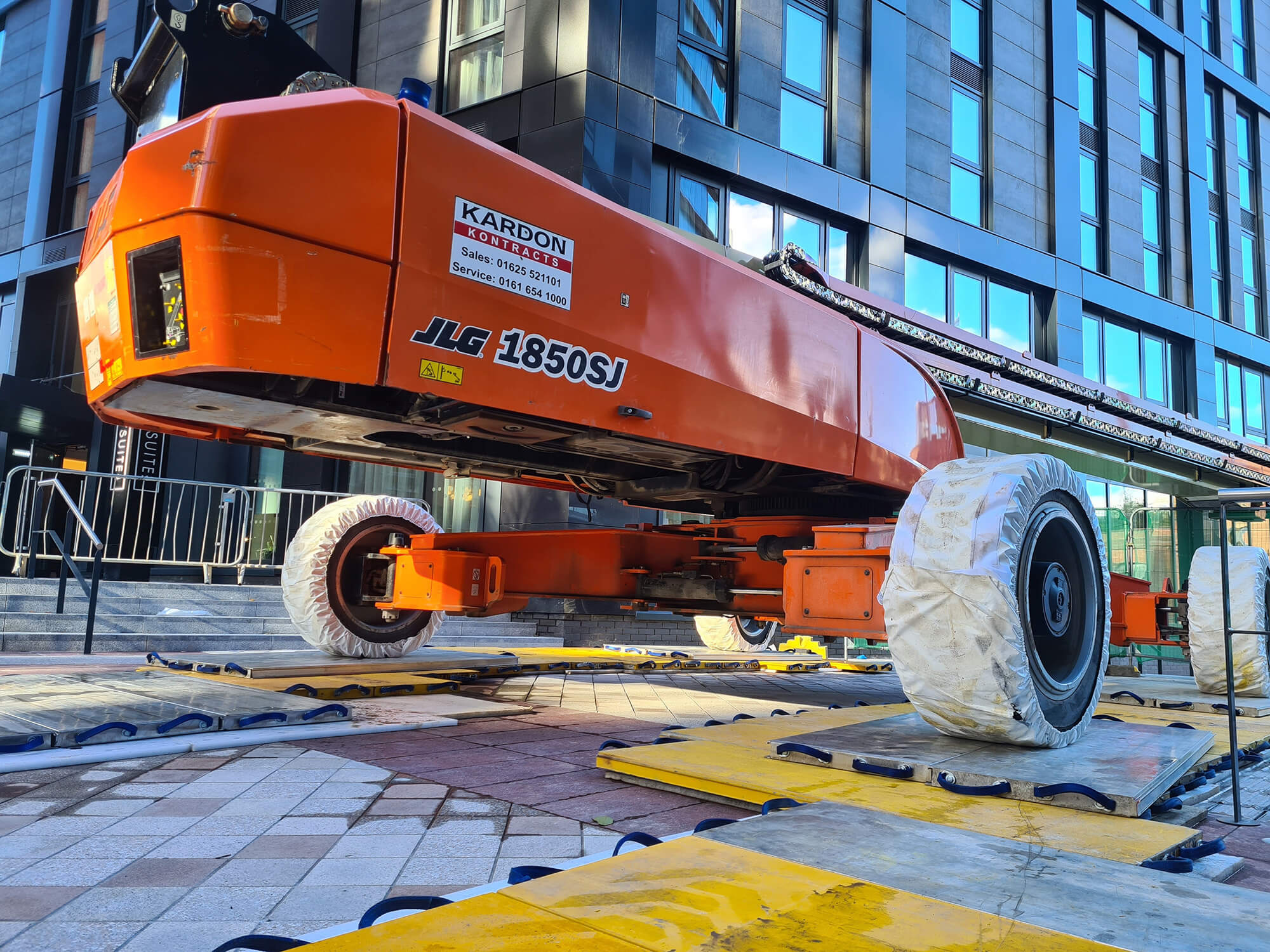
That is why we see our aluminium mats go out under MEWP outriggers as routinely as they do under cranes and pumps, even though an access platform will never load one anywhere near its rated capacity. On this kind of work the point isn't headroom — it's keeping every contact point flat and level whatever's underneath it, and getting that right before the platform goes up, every time, on whatever ground the machine was driven onto that morning.
The same machine, a different bit of ground every day
Few machines work across as wide a range of ground as a MEWP does. The same scissor lift that spent Monday on a warehouse floor — level, hard, indoors, about as forgiving as ground gets — might spend Tuesday on a worn and patched retail car park, Wednesday on an event site pitched on grass that's had rain on it all week, and Thursday on an industrial yard of compacted hardcore that looks solid but isn't uniformly compacted. A boom lift on a utility or agricultural job might never touch a hard surface at all.
That variety is the real problem. An operator who's spent months on decent hardstanding builds habits — drive out, set up, straight to raising the platform — that are perfectly reasonable on the ground they know and genuinely risky on the ground they don't. "Check the ground" means something different every single time, and the machine itself can't tell hardstanding from a rain-softened field until an outrigger starts to sink into it.
Why outrigger and stabiliser pads are standard kit, not an optional extra
Most boom lifts, and the larger scissor lifts, are built around outriggers or stabilisers making firm, level contact at every point before the platform will rise. Lose contact at one point, or let one corner sink even slightly more than the others, and the stability envelope the manufacturer designed around no longer applies — it assumed four solid points, not three solid ones and a soft one. That's why manufacturer operating manuals and IPAF operator training both treat pads under outriggers and stabilisers as standard equipment for anything short of solid, level hardstanding, rather than something reached for only on obviously bad ground.
There's a second job the pads do that doesn't come up under cranes or pumps in the same way — levelling. Every scissor lift and boom lift has a maximum permissible ground slope or chassis tilt before its own sensor cuts the machine out, a built-in limit rather than a judgement call, so a pad that only spreads load over soft ground is doing half the job. The other half is keeping the machine inside its tilt tolerance in the first place, on ground that might be firm enough to bear the weight but not flat enough to keep the sensor happy.
Where ALIMATS come in on a MEWP job
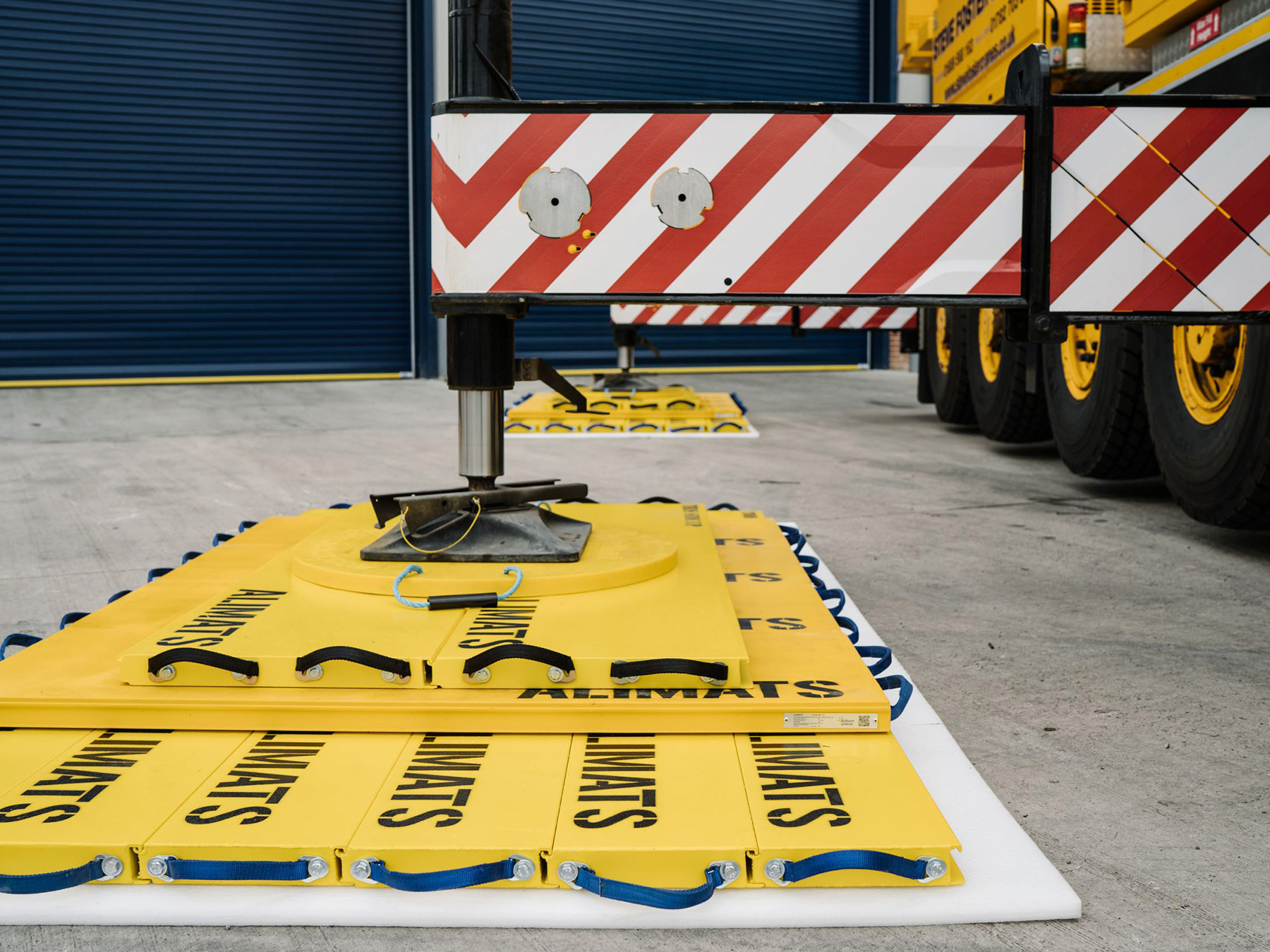
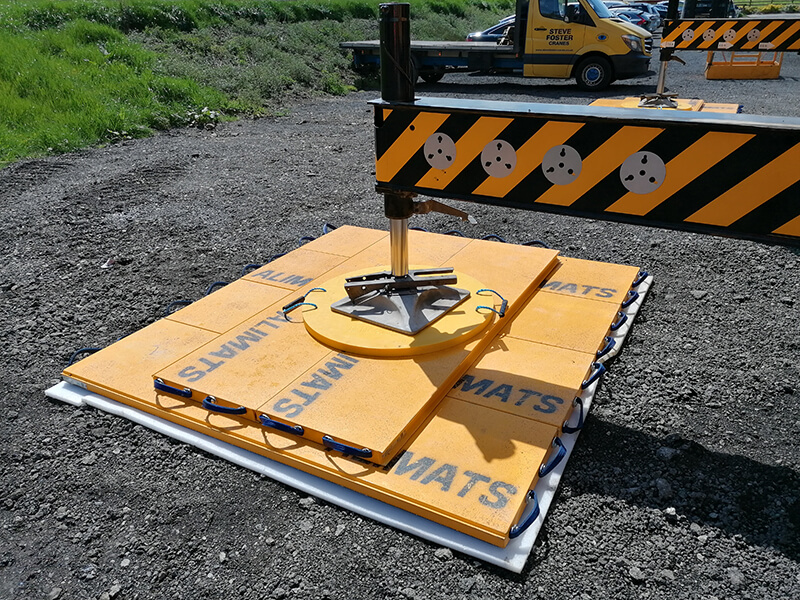
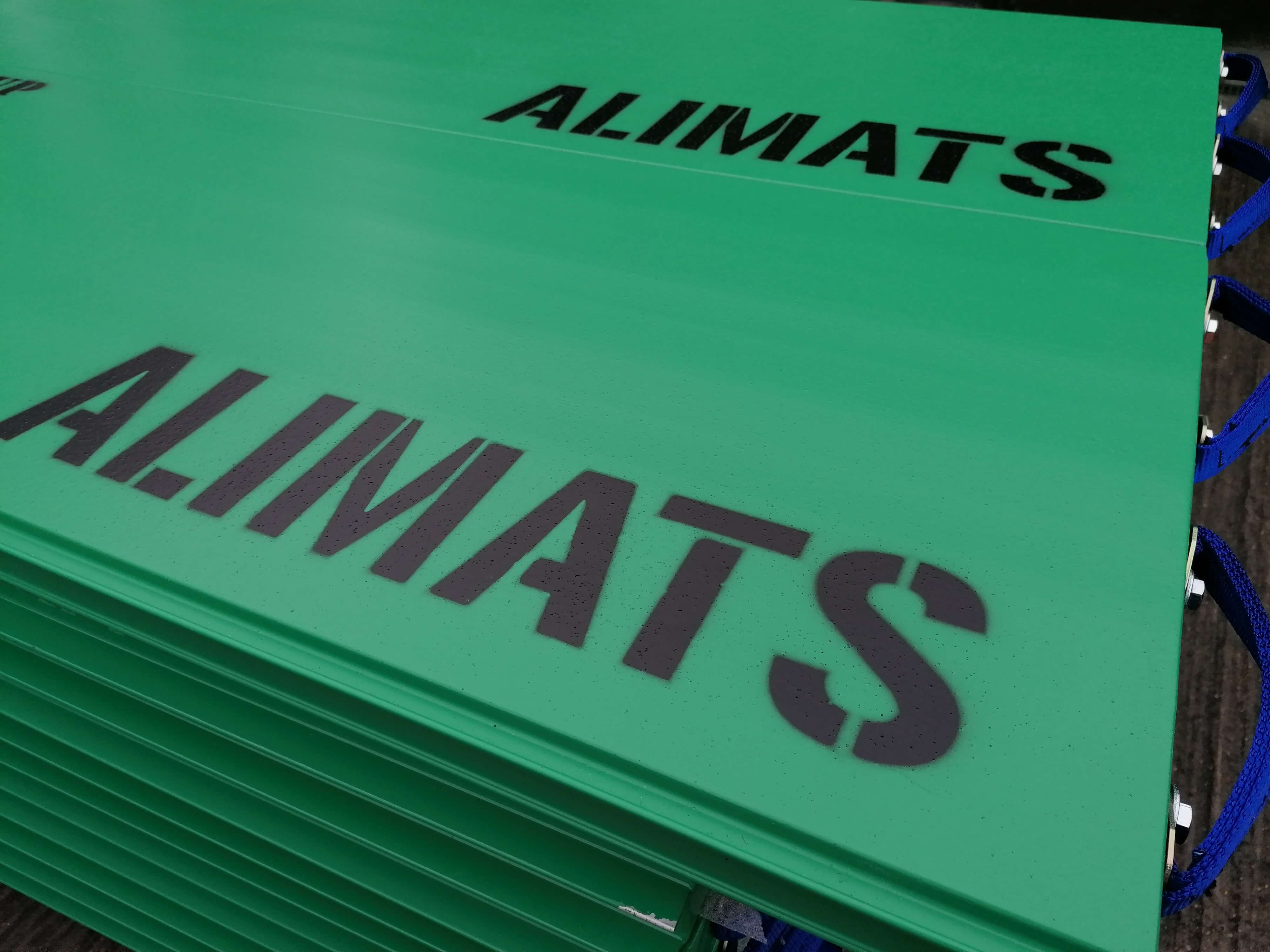
ALIMATS is our modular aluminium mat system, machined from 6005A alloy and built from five panel sizes — from a 0.58 x 0.58m Mini at 13kg up to a 3480 x 290mm Extra Long at 48kg — that combine into configurations from 1.34m2 right up to 8.07m2. None of that range was designed with MEWPs in mind. The system is rated up to 80 tonnes SWL, every figure independently checked with a Fellow of the Institution of Structural Engineers, because the same mats go out under crawler cranes and concrete pump legs loading several tonnes onto a single pad. A MEWP stabiliser foot will never come close to testing that headroom.
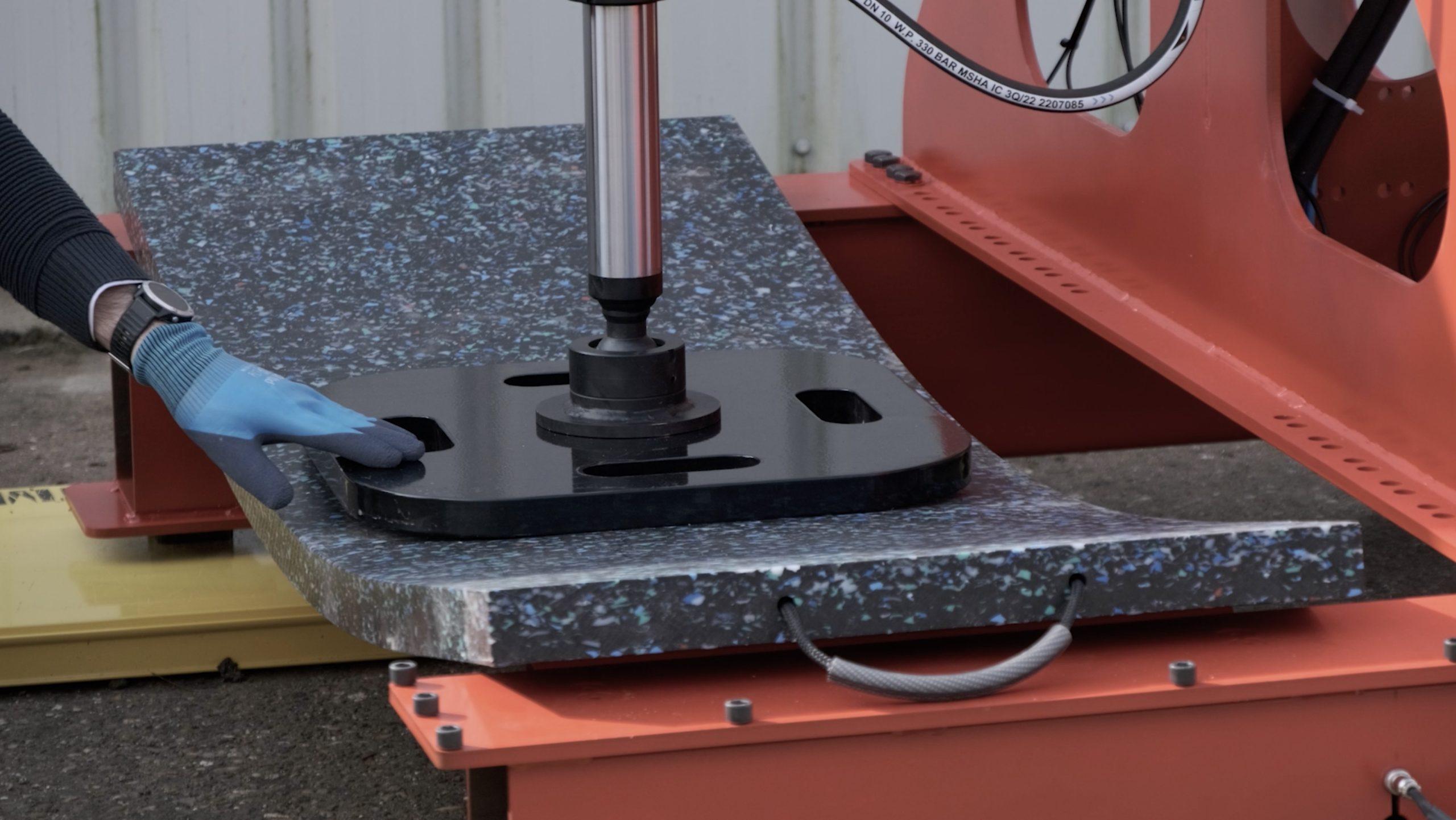
What it does test is flatness and consistency — and that's where the aluminium earns its keep over the plastic mats you'll find on the same sites. Independent bending tests measured ALIMATS deflecting in single millimetres where a comparable UHMWPE plastic mat deflected in tens of centimetres under the same load; the full figures are in our aluminium versus plastic bending test. A mat flexing by more than ten centimetres isn't holding a level surface for a tilt sensor to trust — it's moving underneath the machine while the platform is up.
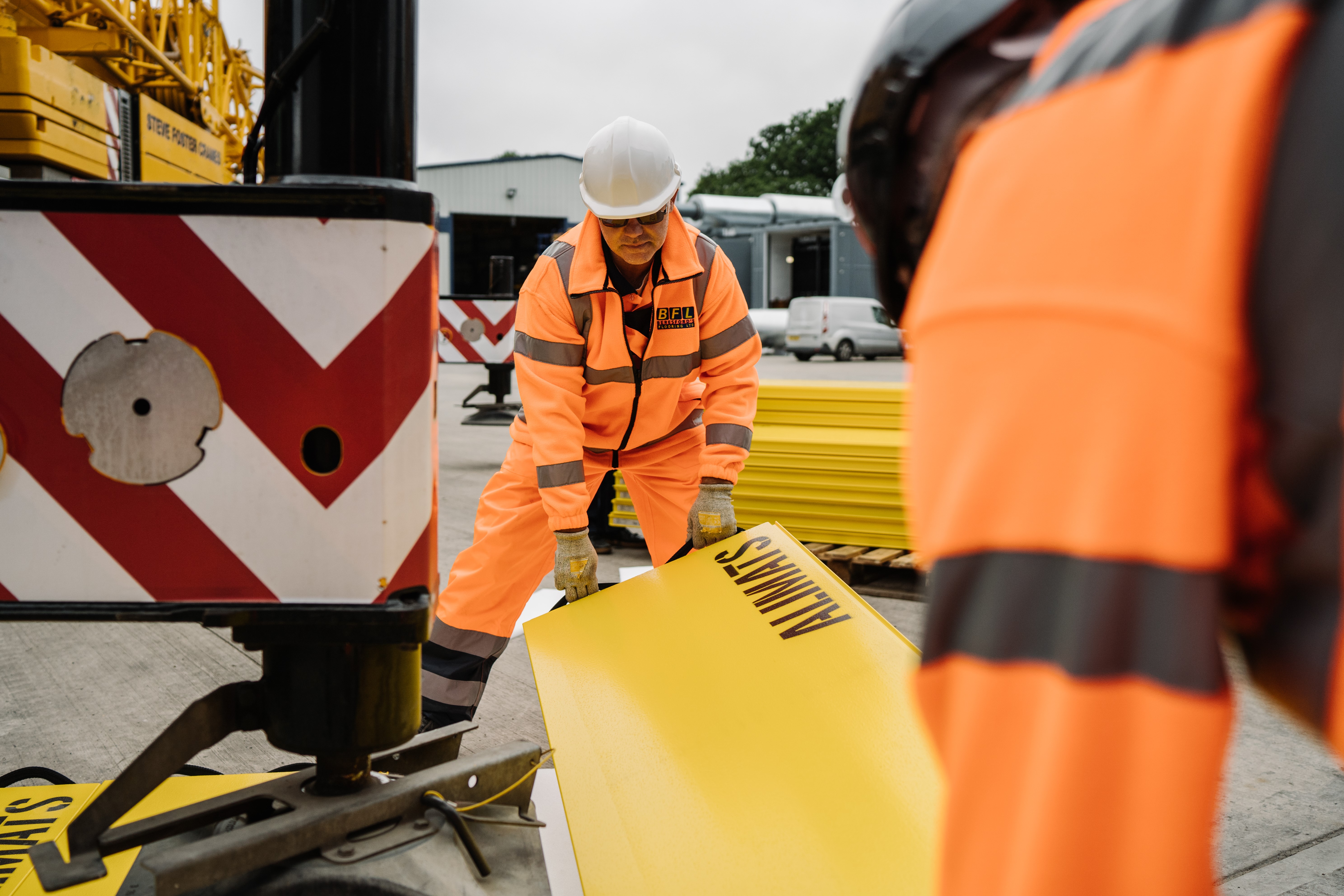
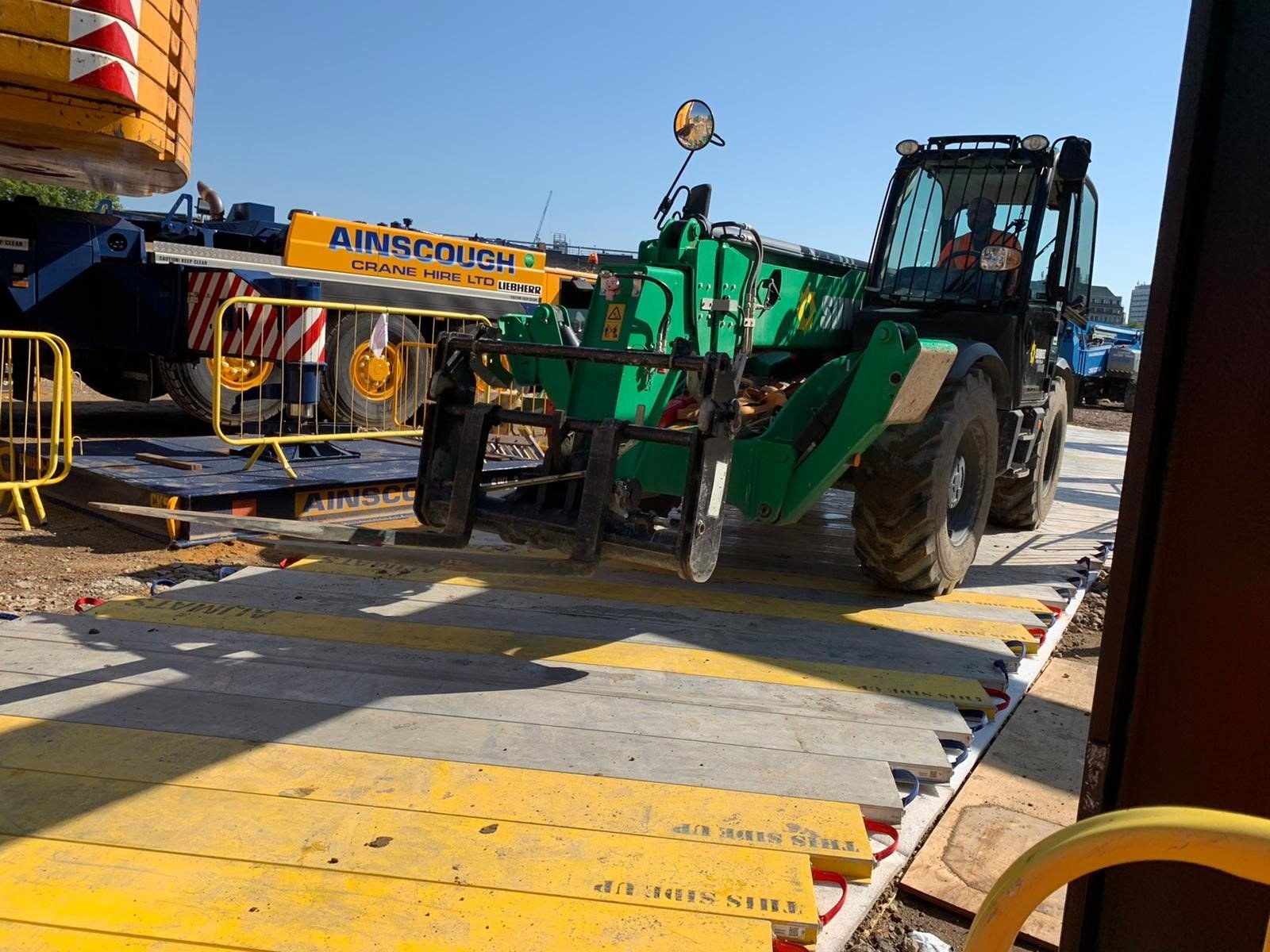
There's a practical point for access crews too — the panels are handleable, light enough for two people to carry and lay by hand with no heavy plant needed. That counts for a lot on this kind of work, where the operator is often working alone or with a single banksman and there's nothing else on site to shift anything heavier.
Hire, buy, and getting pads to an unfamiliar site
MEWP work often lands at short notice — a scissor lift booked for a two-day warehouse job, a boom lift wanted on an event site for the weekend — which is one reason we offer ALIMATS on day, week or long-term hire as well as outright purchase. We run our own FORS Bronze-accredited fleet and deliver 24/7 across the UK, and that counts for more on access work than it does almost anywhere else: ground protection that turns up the day after the machine does is no use to anyone.
Every mat that comes back from hire is inspected, cleaned and checked before it goes out again, so a set of pads that spent last month under a boom lift on a muddy utility site arrives at the next job — MEWP, crane or pump — in a condition we've actually checked, not just assumed.
Working out how many pads you need
Stabiliser footprints, ground bearing conditions and machine weights vary so much from one job to the next that there's no single answer to "how many pads" that holds across a warehouse floor and a rain-softened field. The MEWP Outrigger Pad Sizing Calculator below works through your machine's outrigger loads and the ground you're working on to suggest a starting configuration — somewhere to begin the conversation with your ground engineer or plant supplier, on the way to a proper site-specific assessment.
MEWP Outrigger Pad Sizing Calculator
Enter your outrigger leg load and allowable ground bearing pressure for an indicative pad recommendation.
Indicative only. Uses general bearing-pressure arithmetic (load ÷ area), not BIL proprietary engineering data. Always confirm pad selection with a qualified temporary works engineer, or request full specs from our technical team before specifying for a live project.
Frequently asked questions
Do all MEWPs need outrigger or stabiliser pads?
Not every MEWP has outriggers — plenty of compact scissor lifts run on their own tyres and rely on tyre-contact ground bearing rather than a separate stabiliser. But any machine that does deploy outriggers or stabilisers should have pads underneath them unless it's set up on solid, level hardstanding known to take the load. Most manufacturer manuals and IPAF operator training treat that as the default, not the exception.
What size pad does a scissor lift or boom lift actually need?
It comes down to the outrigger or stabiliser foot size, the machine's weight and load distribution, and the bearing capacity of the ground on the day — which is why there's no single stock answer. Use the sizing calculator above as your starting point, and treat unusual or clearly soft ground as a reason to get a specific recommendation rather than guessing upward. Call us on 01335 345111 if you'd like us to work it through with you.
Can I use timber or plastic mats instead of aluminium ones?
On genuinely firm ground, timber or plastic can be perfectly adequate. Where aluminium earns its keep is on softer or less consistent ground, because a mat that flexes noticeably under load isn't holding the flat, level surface a MEWP's tilt sensor and outrigger set-up are relying on — it's moving underneath the machine while the platform is raised. Our bending tests put real numbers on that gap.
How is ground assessment for a MEWP different from a ground-bearing survey for a crane?
A crane lift often gets a formal, engineered ground-bearing assessment worked out in advance for a specific pick. MEWP ground checks are usually built into the operator's daily pre-use routine — a practical, on-the-spot assessment repeated every time the machine moves to new ground, rather than a one-off survey. Either way, unusual or clearly poor ground warrants engineer input.
Do pads help with sloping ground, or only soft ground?
Both, up to a point. A pad can take up minor unevenness and stop a stabiliser sinking unevenly into soft ground, but it can't correct a slope that's beyond the machine's own permissible tilt limit. Finding ground within the machine's rated slope tolerance still comes first — the pads support that job, they don't replace it.
Can one or two people put pads out under a MEWP without extra plant on site?
Yes — and that's one of the practical reasons aluminium suits access work in particular. Most ALIMATS panels weigh well under 50kg and are built to be carried and positioned by two people by hand, which matters when a MEWP crew often doesn't have a telehandler or anything similar sitting idle to move ground protection around.
How quickly can pads get to site?
We supply ALIMATS on day, week or long-term hire, or for outright purchase, and deliver across the UK on our own FORS Bronze-accredited fleet, 24/7. That matters on MEWP work especially, where machines are often booked at short notice for jobs lasting a day or two.
Do scissor lifts and boom lifts need different pads?
Both work on the same principle — firm, level, load-spread contact at every outrigger or stabiliser point — but boom lifts more commonly deploy outriggers carrying higher point loads, because the boom's reach shifts weight toward one side of the machine when it's extended. Scissor lifts vary more by model, so it's worth checking whether a given machine even has stabilisers before you assume anything about its pad requirements.