
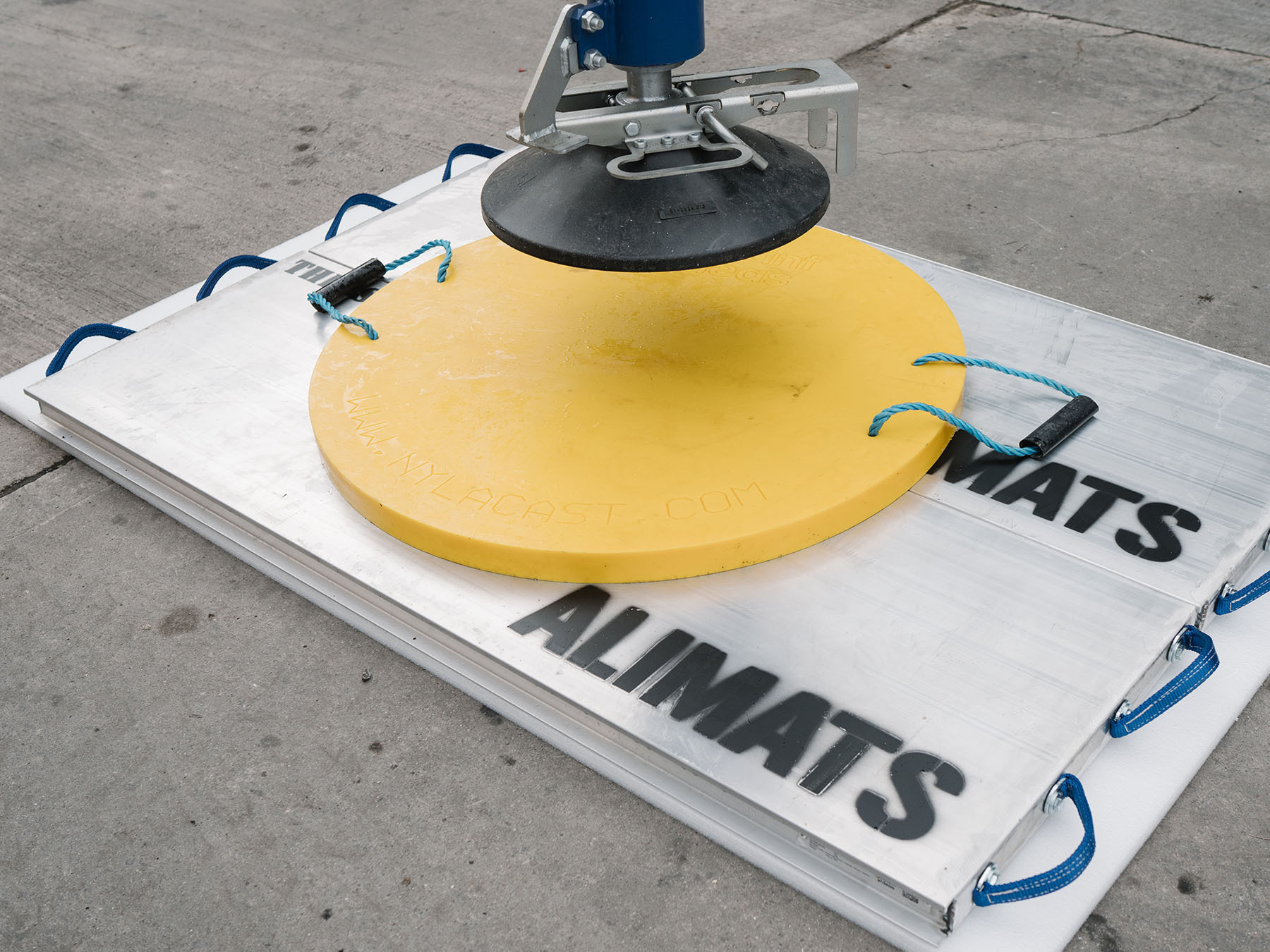
Not every outrigger job calls for a full mat configuration. A MEWP levelling its feet on a car park, a concrete pump dropping its stabilisers onto a domestic driveway, a smaller mobile crane working within its rated capacity on reasonably firm ground — in each of these the product actually doing the work is a single ground-bearing pad, roughly a square metre or less, not a multi-module mat built up from interlocking panels. That's a different product category with a different set of trade-offs, and it deserves a straight answer of its own.
We've already put ALIMATS aluminium head to head with a competing UHMW-PE plastic mat under a controlled load — the numbers are in Aluminium vs Plastic Crane Mats: The Bending Test, and that's the piece to read if you want mat-scale deflection under load. The question that sits just underneath it is the one we get asked more often on site: what do you actually put under a single outrigger foot, and is "HDPE pad" even a single, well-defined answer? It isn't — and that's worth pulling apart.
Where pads end and mats begin
In practice the industry draws the line at around one square metre. Below that, you're looking at a single round or square pad sized to sit under one outrigger foot. Above it, load spread requirements push you into modular mat configurations — several interlocking panels engineered to distribute a heavier point load across a wider bearing area.
The two categories aren't mutually exclusive, either. On larger jobs we regularly see a Nylacast pad sat on top of a mat configuration — the mat doing the bulk of the load-spreading work, the pad on top optimising the final point of contact and protecting the mat surface from a concentrated steel foot. So the pad-versus-mat call and the pad-material call are genuinely two separate questions, and it's the second one — which material actually goes under the foot — that trips most people up.
What "HDPE pad" actually means
Ask around a site and you'll hear "HDPE pad", "plastic pad" and "UHMWPE pad" thrown around as if they all describe the same thing. They don't. HDPE (high-density polyethylene) and UHMWPE (ultra-high molecular weight polyethylene) are related polymers — both genuinely plastic, both genuinely non-metallic — but "a plastic pad" tells you almost nothing about how it was formulated, what additives or reinforcement went into it, or what certification stands behind it.
This matters because the pad market has a wide quality spread. At one end sits generic, uncertified HDPE stock cut to size — cheap, everywhere, and exactly as strong as ordinary HDPE is, no more. At the other end sits material specifically formulated and certified for load-bearing ground protection, such as Nylanite, the material Nylacast use in their certified Big Foot pads. Both get called "a plastic pad". Only one of them is the product we actually recommend for this category.
HDPE's honest advantages
HDPE has real advantages, and on the right job it's the right call. It's cheap and it's everywhere — most plant hire counters and builders' merchants stock it, so replacing a damaged pad is rarely a supply-chain headache. It's genuinely non-conductive, in the same way timber is, which is a real consideration anywhere you're working near live electrical equipment and a metal pad would be the wrong choice regardless of its structural merits.
It doesn't corrode, either, for the simple reason that it isn't a metal at all — no rust, no galvanic reaction with wet ground or standing water, no long-term degradation from that particular mechanism. That's one thing aluminium, for all its other strengths, can't quite claim in the same terms; aluminium resists corrosion very well, but it's still a metal. For light, infrequent, budget-driven work, generic HDPE earns its place, and we'll say so.
The stiffness problem under concentrated loads
Where HDPE and UHMWPE run into trouble is stiffness under a concentrated point load — which is exactly what an outrigger foot delivers. Our bending test shows how this plays out at mat scale, and the mechanism is identical at pad scale, because stiffness is a property of the material, not the size of the module.
A pad that flexes visibly under load has a smaller effective bearing area than its footprint on paper suggests — it dishes rather than staying flat, concentrating pressure back towards the centre instead of spreading it evenly out to the edges. On light loads well within a generic HDPE pad's comfortable range, that's rarely a problem in practice. Push the load towards the upper end of what a sub-1m² pad is being asked to carry, and it becomes the exact property that separates a merely adequate pad from a genuinely load-engineered one.
Why Nylanite, not generic HDPE
This is why, in the sub-1m² pad category, we don't recommend standard HDPE at all — we recommend certified Nylacast Big Foot pads, made from Nylanite. Nylanite isn't a rebrand of the same polymer; it's a distinctly different, notably stronger and more impact-resistant material, and the property numbers against generic HDPE — with ALIMATS aluminium alongside for context — settle the point rather than leaving it to marketing language.
Compressive strength is roughly six times higher, tensile strength nearly three times higher, and the modulus of elasticity — the direct measure of stiffness under load — is more than double. In practical terms that's a pad which resists the same dishing and edge-loading behaviour described above at meaningfully higher loads than generic HDPE can manage, while staying non-conductive, non-metallic, and keeping the corrosion advantages that whole category offers. It's about as close as the pad-scale market gets to the benefits of plastic without plastic's structural weak point.
| Property | Nylanite (Nylacast Big Foot) | HDPE (UHMWPE, generic) | ALIMATS Aluminium (6005A) |
|---|---|---|---|
Compressive strength | 123 MPa | 21 MPa | 280 MPa |
Tensile strength | 78 MPa | 28 MPa | 270 MPa |
Modulus of elasticity | 3,000 MPa | 1,350 MPa | ~69,000 MPa |
Material density | 1,380 kg/m3 | 960 kg/m3 | 2,700 kg/m3 |
Property:
Nylanite (Nylacast Big Foot):
HDPE (UHMWPE, generic):
ALIMATS Aluminium (6005A):
Property:
Nylanite (Nylacast Big Foot):
HDPE (UHMWPE, generic):
ALIMATS Aluminium (6005A):
Property:
Nylanite (Nylacast Big Foot):
HDPE (UHMWPE, generic):
ALIMATS Aluminium (6005A):
Property:
Nylanite (Nylacast Big Foot):
HDPE (UHMWPE, generic):
ALIMATS Aluminium (6005A):
Where aluminium fits at pad scale
Aluminium comes into this category at its smallest module sizes. ALIMATS® is our patented modular mat system in 6005A aluminium alloy, and while most of the range is built for full mat configurations, the Mini module (0.58 x 0.58m, 13kg) and Short module (1160 x 580mm, 25kg) sit at pad-adjacent dimensions — small enough for the same jobs a single pad would cover, but cut from the same aluminium the mat-scale bending test measures.
The trade-off is simple. Aluminium is a metal, so it doesn't share HDPE's non-conductivity, and it costs more than a generic HDPE pad up front. What you get back is the stiffness the bending-test data demonstrates — independently verified with a Fellow of the Institution of Structural Engineers — a system rated up to 80 tonnes SWL across the wider range, and handleable modules light enough for two people to lift without heavy plant. Every unit is inspected, cleaned and checked before it goes back out, available on hire — day, week or long-term — or for purchase, with 24/7 UK delivery.
Choosing between HDPE, Nylanite and aluminium
At pad scale the decision should come down to what the job actually needs, not habit. If you're working near live electrical equipment, or the loads are genuinely light and infrequent and budget is the driving constraint, generic HDPE is a defensible choice — just go in knowing that not all "plastic pads" are equal, and that the cheapest option is the weaker end of the category rather than a fair sample of it.
If the load is heavier, more concentrated, or the pad is doing repeated, commercial-frequency work, certified Nylacast Nylanite is the step up we'd point you to within the non-metallic category, and the property data above is exactly why. And where the loads start pushing towards mat-scale territory, or a reusable aluminium asset makes more sense across many jobs than replacing plastic pads one at a time, ALIMATS Mini and Short modules bring genuine mat-scale stiffness down to pad-scale dimensions.
Frequently asked questions
What's the actual size cutoff between an outrigger pad and a crane mat?
The industry generally treats around one square metre as the threshold. Below that, a single round or square pad under one outrigger foot is the usual product; above it, load spread requirements push you into modular mat configurations built from several interlocking panels.
Is HDPE the same material as UHMWPE?
They're related polyethylene polymers, but not the same thing — UHMWPE has a much higher molecular weight, which generally gives it better wear and impact resistance than standard HDPE. Neither term on its own tells you whether a given pad is generic stock or an engineered, certified product, and that's the distinction that actually matters when you're specifying one.
Why do you recommend Nylacast Big Foot pads instead of standard HDPE pads?
Because Nylanite — the material Nylacast use in their certified Big Foot pads — is a distinctly stronger and stiffer material than generic HDPE, not just a branded version of the same thing. In the sub-1m² category, that extra stiffness translates straight into better resistance to the flexing and dishing that eats into a plastic pad's effective load spread under a concentrated outrigger foot.
Can a Nylacast pad be used together with an aluminium mat?
Yes, and on larger jobs it's a common combination. The mat configuration spreads the load across a wide bearing area, while a Nylacast pad on top optimises the final point of contact under the outrigger foot and protects the mat surface from concentrated wear.
Does aluminium corrode outdoors the way steel does?
Aluminium forms a stable oxide layer that resists corrosion very well in normal outdoor and site conditions, which is why we build ALIMATS from 6005A alloy rather than steel. It's still a metal, though, so it doesn't share HDPE's complete immunity to every corrosion mechanism, and it isn't electrically non-conductive the way timber or HDPE is.
Is an aluminium pad overkill for a single MEWP setting up on a car park?
For light, infrequent work well within a standard HDPE pad's capability, a generic HDPE pad is usually a perfectly sensible, low-cost choice. ALIMATS Mini and Short modules earn their keep more clearly on repeated commercial use, heavier point loads, or where a reusable long-term asset makes more sense than replacing plastic pads over time.
How much stronger is Nylanite than generic HDPE in practice?
On our published material data, Nylanite has roughly six times the compressive strength of generic HDPE (123 MPa against 21 MPa), nearly three times the tensile strength (78 MPa against 28 MPa), and more than double the stiffness as measured by modulus of elasticity (3,000 MPa against 1,350 MPa).
Where can I get ALIMATS Mini or Short modules for pad-scale jobs?
They're available through us on hire — day, week or long-term — or for outright purchase, with 24/7 UK delivery. Every module is inspected, cleaned and checked before it's redeployed to the next job.
Is HDPE actually safe to use near live electrical equipment, unlike a metal pad?
Yes — HDPE is genuinely non-conductive, in the same category as timber, and that's a real, legitimate reason to choose it over any metal pad, aluminium included, when you're working near live electrical systems. That electrical-safety property is separate from the load-bearing stiffness question, so weigh the two independently when you specify a pad.