
Every trade carries its own shorthand, and ours is thick with it — lift plans, ground investigation reports and temporary works permits are full of terms that mean something specific and rarely obvious to anyone outside the job. We've gathered the ones that come up most often here, in one place, so the vocabulary stops getting in the way of the decision.
It's arranged alphabetically rather than by topic — treat it as a look-up reference, not something to read start to finish. If an unfamiliar term turns up on a permit, a duty chart or a ground report, it should be in here, and where a word bears directly on how mats actually spread load we've said so plainly rather than leaving you to join the dots.
| Term | Definition |
|---|---|
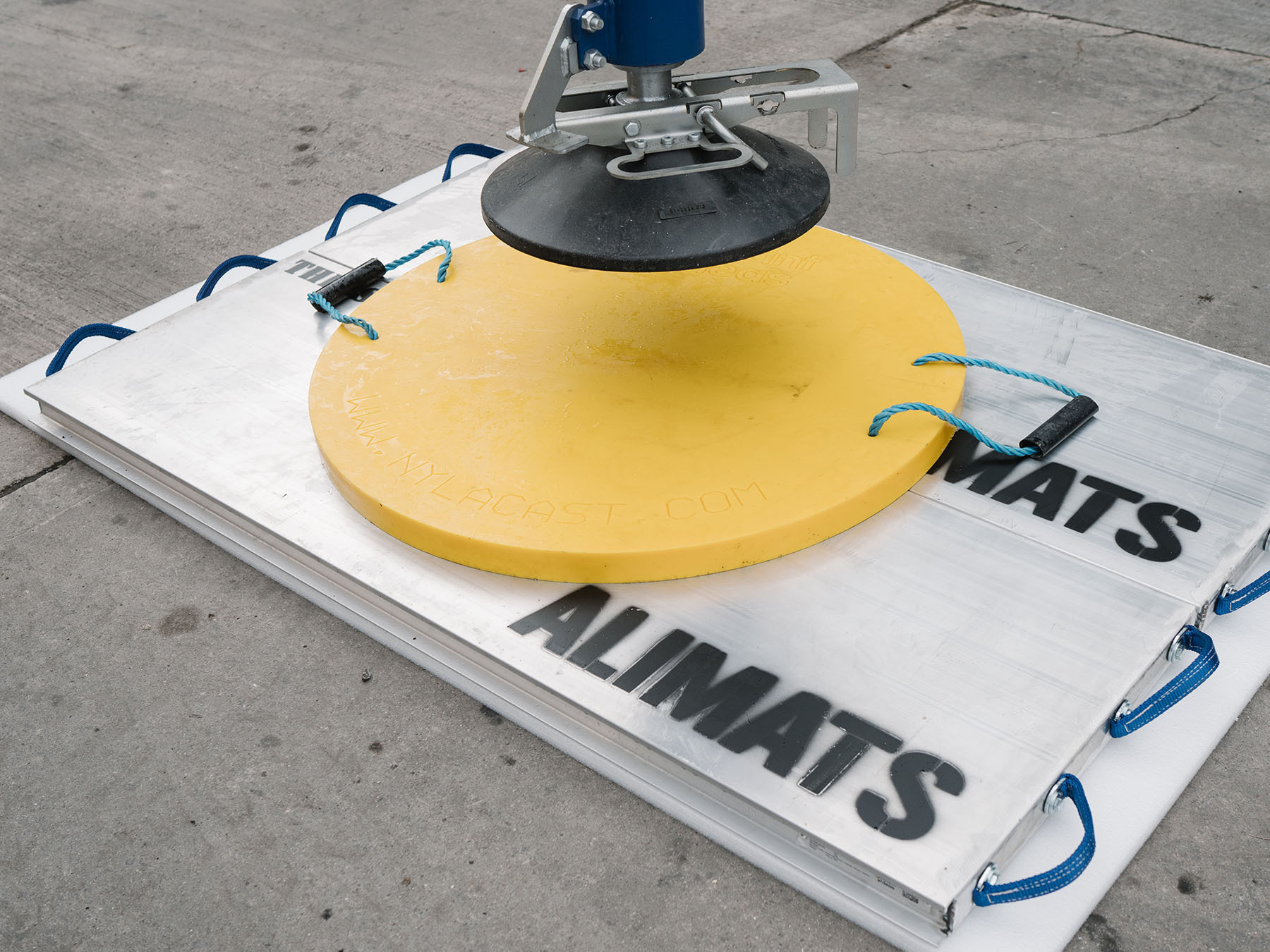
Aluminium alloy | The family of lightweight, corrosion-resistant metal alloys — aluminium combined with elements such as magnesium, silicon or zinc — used to manufacture structural products including crane mats. Aluminium alloys give a high strength-to-weight ratio compared with steel, so a mat with equivalent load-carrying capacity is significantly lighter to handle. Our ALIMATS® range is manufactured from aluminium alloy for this reason. |
Appointed Person | The individual responsible for the overall planning and management of a lifting operation, including selecting the crane, assessing ground conditions and approving the lift plan. On complex or high-risk lifts the appointed person is often a separate role from the crane supervisor; on simpler lifts, one person may hold both responsibilities. |
Ballast | Additional weight, such as concrete or steel blocks, added to a crane or piece of plant to increase stability and counteract the overturning effect of a load. Ballast increases the loads transmitted to the ground through tracks, wheels or outriggers, so it must be accounted for in ground-bearing calculations, not just the load being lifted. |
Bearing pressure | The load per unit area transmitted from a foundation, outrigger, track or mat down into the supporting ground, usually expressed in kilonewtons per square metre (kN/m2). Comparing the applied bearing pressure against the ground's bearing capacity is the basic calculation behind every ground protection decision. |
Boom pump / concrete pump stabiliser | The outrigger legs a truck-mounted concrete boom pump extends to spread its footprint and support the reaction loads generated while pumping, similar in principle to a crane's outriggers. Because boom pumps can impose high, sustained point loads while stationary for long pours, their stabiliser pads often need the same ground protection as crane outriggers. |
Competent person | Someone with the training, knowledge and experience appropriate to a given task — such as inspecting a working platform or checking a lift plan — so that they can identify risks and judge whether work is being carried out safely. What counts as "competent" varies with the complexity and risk of the specific task in question. |
Compressive strength | A material property describing the maximum compressive stress a material can withstand before it fails or crushes, usually expressed in megapascals (MPa) or newtons per square millimetre (N/mm2). It's one of the key properties used to judge whether a mat, pad or timber baulk can carry a given bearing pressure without crushing. |
Crane mat | A load-spreading panel, usually rectangular, placed on the ground beneath a crane's outriggers, tracks or wheels to reduce the bearing pressure transmitted to the ground and prevent it failing or the plant sinking. Crane mats are made from various materials — including timber, steel, aluminium and UHMWPE/HDPE plastics — and are sized according to the load to be spread and the ground conditions on site. |
Crane supervisor | The person on site responsible for directing the crane operation once the lift plan has been approved by the appointed person, including confirming the crane is correctly positioned, ballasted and set up before lifting begins. On smaller or more straightforward lifts, the appointed person and crane supervisor may be the same individual. |
Deflection | The amount a mat, pad or structural element bends or displaces under load. A degree of deflection is normal and expected in most materials; the concern in ground protection is whether it's small enough, and recovers fully once the load is removed, so that it doesn't damage the ground or affect the stability of the plant standing on it. |
Density | A material property describing mass per unit volume, usually expressed in kilograms per cubic metre (kg/m3). Density affects how heavy and manoeuvrable a mat or component is to handle on site, independently of its strength or stiffness. |
Design check | An independent review of a temporary works design carried out by someone not involved in producing the original design, to a level of scrutiny appropriate to the risk category of the works. The design check is a key control point before a permit to load or permit to use is issued. |
Ekki / Azobe | A dense, naturally durable tropical hardwood (Lophira alata), widely used for crane mats and timber baulks because of its high strength and resistance to decay and abrasion. Ekki mats are heavier than aluminium or UHMWPE mats of similar size, and their load capacity can vary with moisture content and natural defects such as knots and splits. |
Exclusion zone | An area around a crane, load or piece of plant from which people are excluded while lifting operations are underway, protecting against the risk of a dropped load, crane instability, or contact with the load or crane structure. Its size is set out in the lift plan and enforced by the signaller and site supervision. |
Factor of safety | The ratio between a material's or structure's actual capacity and the maximum load it's designed to carry, built in to allow for uncertainties in loading, material variability and workmanship. A stated safe working load already has an appropriate factor of safety applied, so it should never be further derated on assumption, nor exceeded on the assumption that spare capacity remains. |
Geotechnical desk study | A preliminary assessment of likely ground conditions carried out by reviewing existing information — historical maps, geological records, previous site investigation reports — before any intrusive ground investigation takes place. It helps identify risks such as made ground or historical structures, and informs the scope of any trial pits or further investigation needed. |
Ground bearing capacity | The maximum bearing pressure the ground can safely support without excessive settlement or failure, established through site investigation and geotechnical assessment. It varies significantly with soil type, moisture content and previous ground disturbance, and is the key figure used to size crane mats and outrigger pads. |
Lift plan | A documented plan for a lifting operation, prepared or approved by the appointed person, setting out the sequence of work, the crane and equipment to be used, ground conditions and protection measures, exclusion zones, and the roles and responsibilities of those involved. A lift plan is required for anything beyond the most basic, repetitive lifting operations. |
Load chart / duty chart | Manufacturer's data, specific to an individual crane, showing the maximum load it can lift at a given radius and configuration, including how outrigger reactions vary with load and radius. The appointed person and crane supervisor use the load chart to confirm a lift is within the crane's capacity and to calculate the ground loads that need to be spread by mats or pads. |
Load spread | The principle of distributing a concentrated load, such as an outrigger point load, over a larger ground area so the resulting bearing pressure is reduced to within the ground's safe bearing capacity. Crane mats and outrigger pads work by load spread, and the degree achieved depends on a mat's size, thickness and stiffness. |
Made ground | Ground that has been altered by human activity, typically by filling, dumping or reworking with material that isn't naturally occurring in that location — demolition rubble, old foundations or uncompacted fill, for example. Made ground is often unpredictable and weaker or less consistent than undisturbed natural ground, so it's a common trigger for additional ground protection or investigation. |
MEWP (Mobile Elevating Work Platform) | A powered platform, such as a scissor lift or boom lift, that raises people to work at height. Like cranes, MEWPs transmit concentrated loads through wheels or outriggers and can require ground protection matting on soft, uneven or made ground to prevent sinking or instability. |
Modulus of elasticity | A material property (also called Young's modulus) describing how much a material stretches or compresses elastically under a given stress — a measure of stiffness rather than strength. Two materials can share the same strength but differ greatly in stiffness, meaning one deflects far more than the other under the same load before either fails. |
Outrigger | An extending leg or beam fitted to a mobile crane (or other plant, such as boom pumps and some MEWPs) that is lowered to the ground to widen the machine's effective base and provide stability while working. Outriggers transmit high, concentrated point loads to the ground, which is why they are typically set up on mats or pads. |
Outrigger pad / outrigger float | A load-spreading pad placed directly under an individual outrigger foot, smaller and more localised than a full crane mat, used to reduce the bearing pressure at that specific point. "Float" is an alternative term used for the same component, particularly in mobile crane hire. |
Outrigger reaction | The vertical load transmitted through an individual outrigger to the ground, which varies with the crane's configuration, the load being lifted, and the radius at which it's working. Outrigger reactions, taken from the crane's load chart, are the starting figures used to size mats or pads for a specific lift. |
Permit to load / permit to use | A formal, documented authorisation confirming that a temporary works item has been constructed, checked and approved, and may now be loaded or brought into use. Issuing the permit is normally the responsibility of the Temporary Works Coordinator, following the required design check and any necessary inspection. |
Piling rig | Heavy plant used to install piled foundations, typically imposing very high, concentrated ground loads through tracks or outriggers, often on ground that hasn't yet been fully engineered. Piling rigs commonly require substantial ground protection, particularly where they need to track across a site between pile positions. |
Plate bearing test | A field test in which a rigid plate is loaded and the resulting settlement measured, used to assess the in-situ bearing capacity and stiffness of the ground at a specific location. It's one of the direct methods used to confirm ground conditions assumed from a desk study or borehole information. |
Point load | A load applied, or treated as applied, at a single, concentrated location rather than spread over an area — the load from an individual outrigger foot, for example. Point loads generally produce much higher local bearing pressures than the same total load applied as a uniformly distributed load, which is why they are the critical case for crane mat sizing. |
Radius | In crane terminology, the horizontal distance from the crane's centre of rotation to the centre of the load being lifted. A crane's safe working load reduces as radius increases, which is why radius is one of the two key figures — with the resulting load — read from a load chart. |
Safe Working Load (SWL) | The maximum load that a piece of equipment, mat, sling or lifting accessory is designed to carry safely, already incorporating an appropriate factor of safety. SWL should always be read together with the specific conditions it applies to — configuration, radius, ground support — since it isn't necessarily a single fixed figure for every situation. |
Slew | The rotation of a crane's upper structure and boom around its vertical axis, allowing the load to be moved to a different radius and direction without moving the crane's base. Slewing changes the position of the load relative to the crane's base, which can alter the loads on individual outriggers even where the load and radius stay constant. |
Slinger / signaller | The person responsible for attaching the load to the crane correctly (slinging) and directing the crane operator's movements using agreed signals or radio communication (signalling) — often the same individual on smaller lifts. Slingers/signallers need specific training in load attachment, sling selection and safe signalling procedure. |
Spider crane / mini crane | A compact, tracked crane with narrow, often outrigger-supported tracks or legs, designed to access confined spaces such as building interiors or narrow side passages that conventional mobile cranes can't reach. Despite their small size, spider cranes can impose significant point loads through their tracks or outriggers and often need matting on delicate floor finishes or soft ground. |
SPT / Standard Penetration Test | A widely used in-situ ground investigation test, carried out in a borehole, in which a sampler is driven into the soil under a standard hammer blow and the number of blows needed to penetrate a set depth is recorded as the "N-value". SPT results give an indication of soil density and strength with depth, and are commonly used alongside trial pits and desk studies to characterise ground conditions. |
Stiffness vs strength | Two distinct material properties that are often confused: strength is the load a material can withstand before it fails, while stiffness (measured by modulus of elasticity) is how much it deflects under load before it gets there. A stiff material limits deflection but isn't necessarily strong, and a strong material isn't necessarily stiff — both matter for crane mat performance, since excessive deflection can be a problem even in a mat that hasn't failed. |
Temporary works | Engineering works needed to allow permanent works to be constructed, but which aren't part of the finished, permanent structure — excavation support, formwork, scaffolding and propping, for example, and, in this context, the crane mats and outrigger pads used to support plant safely on site. Temporary works still need to be properly designed, checked and managed, even though they're removed once no longer required. |
Temporary Works Coordinator (TWC) | The person appointed by a contractor to manage the overall temporary works process on a project or site, ensuring temporary works are designed, checked and given a permit to load or use before they're relied upon. The TWC role is a management and coordination function, not necessarily a design role. |
Temporary Works Supervisor (TWS) | The person responsible for supervising a specific temporary works item on site, checking it's constructed, positioned and maintained in accordance with its design, and reporting to the Temporary Works Coordinator. On smaller sites, the TWS role may be combined with other site supervisory responsibilities. |
Tensile strength | A material property describing the maximum tensile (pulling or stretching) stress a material can withstand before it fails, usually expressed in megapascals (MPa) or newtons per square millimetre (N/mm2). Materials can behave very differently in tension and compression, so tensile and compressive strength are both relevant depending on how a component is loaded in service. |
Track mat / trackway | Lighter, often modular matting laid end-to-end to create a temporary road or path for tracked or wheeled plant to travel across soft or sensitive ground, as distinct from a crane mat, which supports a stationary load at a single fixed position. Track mats are generally sized for distributed traffic loading rather than the concentrated point loads a crane mat must resist. |
Trial pit | A shallow excavation dug during a ground investigation to allow direct visual inspection of the soil profile, and to take samples or carry out simple in-situ tests. Trial pits are a relatively quick and low-cost way of confirming near-surface ground conditions, though they're limited in depth compared with boreholes. |
Triangulation | In crane mat design, positioning mats or pads so their footprint distributes load across multiple bearing points, or arranging multiple mats to bridge weak spots and tie the load path back to firmer ground. The term is also used more generally in lift planning to describe locating the crane relative to underground services or obstructions using multiple reference measurements. |
UHMWPE / HDPE | Ultra-high-molecular-weight polyethylene (UHMWPE) and high-density polyethylene (HDPE) are engineering plastics used to manufacture lightweight ground protection mats and outrigger pads. They offer good wear and moisture resistance and don't absorb water or rot the way timber can, though their load capacity and stiffness differ from aluminium or timber alternatives and depend on the specific grade and thickness used. |
Uniformly Distributed Load (UDL) | A load treated as spread evenly across an area rather than concentrated at a single point — the loading from a general work platform or stored materials over a floor or ground area, for example. UDLs generally produce lower local bearing pressures than an equivalent point load, which is why point loads, such as outrigger feet, are usually the governing case for crane mat design. |
Working platform | An engineered surface built up to provide a stable base of sufficient bearing capacity for a crane or other plant to work from, typically used where the natural or made ground alone isn't adequate. A working platform is itself a piece of temporary works, and its design should be checked and certified before plant is brought onto it — distinct from the same term's use in work-at-height contexts, such as a MEWP or scaffold platform. |
Term:
Definition:
Term:
Definition:
Term:
Definition:
Term:
Definition:
Term:
Definition:
Term:
Definition:
Term:
Definition:
Term:
Definition:
Term:
Definition:
Term:
Definition:
Term:
Definition:
Term:
Definition:
Term:
Definition:
Term:
Definition:
Term:
Definition:
Term:
Definition:
Term:
Definition:
Term:
Definition:
Term:
Definition:
Term:
Definition:
Term:
Definition:
Term:
Definition:
Term:
Definition:
Term:
Definition:
Term:
Definition:
Term:
Definition:
Term:
Definition:
Term:
Definition:
Term:
Definition:
Term:
Definition:
Term:
Definition:
Term:
Definition:
Term:
Definition:
Term:
Definition:
Term:
Definition:
Term:
Definition:
Term:
Definition:
Term:
Definition:
Term:
Definition:
Term:
Definition:
Term:
Definition:
Term:
Definition:
Term:
Definition:
Term:
Definition:
Term:
Definition:
Term:
Definition:
Term:
Definition: