
Ground bearing capacity gets treated, far more often than it should be, as a single number picked off a table or half-remembered from a similar job down the road. It is nothing of the sort. It describes something very specific — the largest pressure a particular patch of ground can carry, at a particular depth, in the particular condition it is in on the day, before something goes wrong. And "something goes wrong" is not one thing. It is two genuinely different failure modes, and in our experience confusing them is where a lot of ground support decisions quietly go astray.
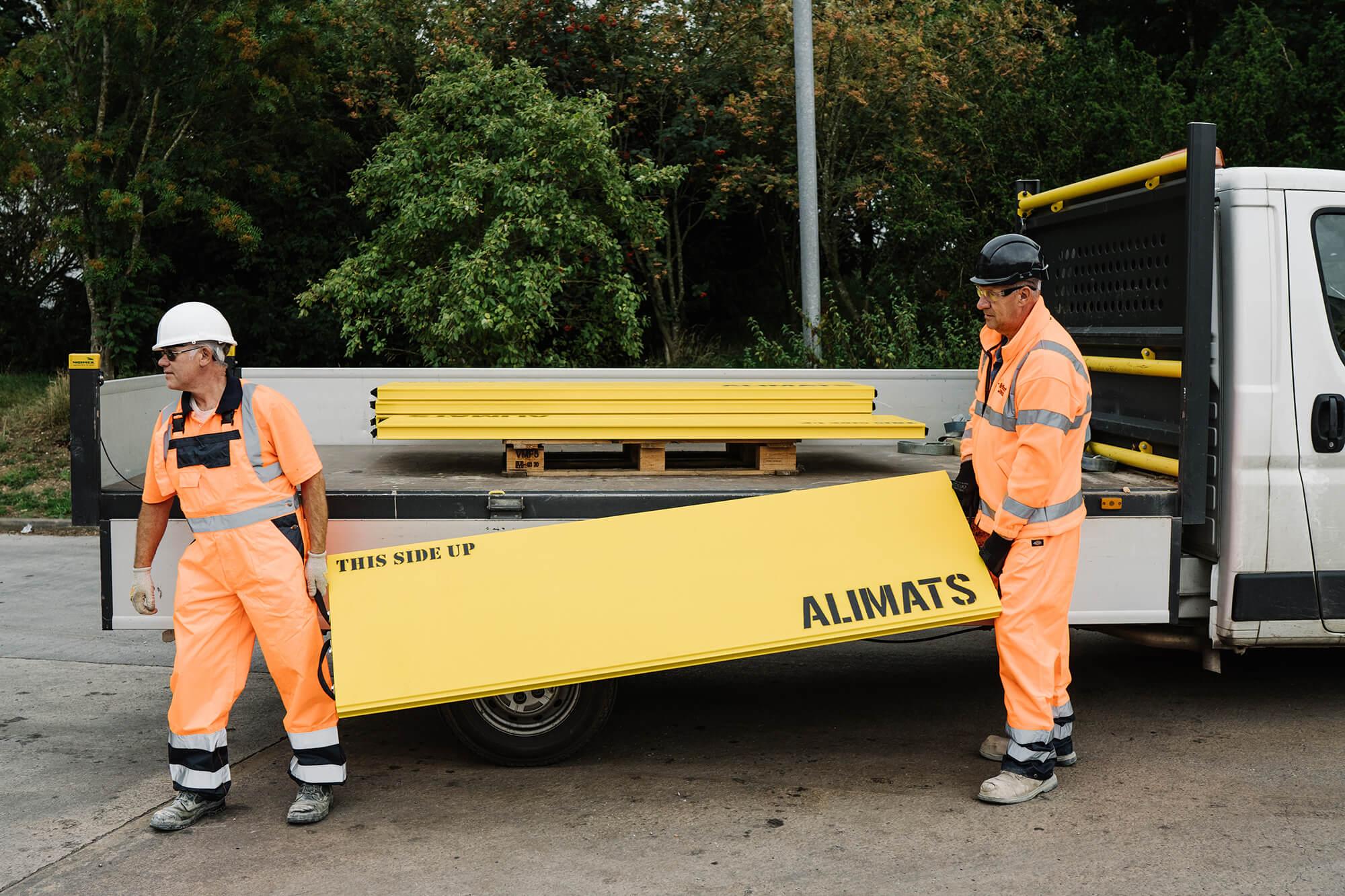
The first is shear failure — the ground giving way suddenly. Load a small footprint hard enough and, past a certain point, the soil beneath it can no longer resist being pushed sideways and upward out of the way. A wedge of ground shears along an internal failure surface and the load punches straight down through it, the same way a boot breaks through thin ice rather than being gently caught by it. This is the failure people picture when they think of ground "giving way": comparatively sudden, and usually obvious once it starts. It is also the ground-side risk our ALIMATS® aluminium crane mats exist to manage — by spreading a concentrated leg or track reaction over enough ground that the resulting pressure stays inside what that patch can actually take. For how a bearing pressure figure turns into a required mat size, see our load spread calculation guide, which covers the arithmetic in full. Here we stay on the ground itself.
The second failure mode is quieter, and on a live site we would argue it is the more dangerous of the two precisely because it does not announce itself. Excessive settlement is the ground not failing outright but compressing under sustained load — squeezing water and air out of its pore spaces, or rearranging its particles under weight — and sinking more than is acceptable, gradually, over the time the load sits there. A crane does not need a leg to punch clean through the ground to become unstable. It only needs one outrigger to settle a few centimetres more than the other three while the load is still up, and the whole platform is now out of level in a way nobody planned for. Settlement is slower, less dramatic, and often only obvious in hindsight — which is exactly why it deserves equal billing with shear failure, not to be filed away as the lesser worry.
What actually determines a patch of ground's bearing capacity
Bearing capacity is not a fixed property of a place. It is the outcome of several factors interacting, and any one of them can move the answer significantly. The starting point is soil or material type: dense gravel, well-compacted sand, stiff clay, soft clay, weathered rock, sound rock and made ground all behave differently under load — not because one is universally "stronger" than another, but because each carries load through a different mechanism.
Density and compaction matter as much as the material itself. Two patches of the same soil, one well-compacted and one loose, can have meaningfully different bearing capacities, because a denser arrangement of particles resists both shear and settlement better — there is simply less room for those particles to rearrange under load. This is why we treat compaction as an engineering activity in its own right, not a cosmetic finishing pass over the surface.
Moisture content is one of the biggest swing factors of all, and it is worth being blunt about it — many soils, clays especially, lose significant bearing capacity when saturated compared with the same material dry. Water sitting in the pore spaces between particles reduces the friction and cohesion holding those particles together, and gives settling ground more room to compress as that water is squeezed out under load. The same clay that comfortably carries an outrigger reaction in a dry spell can behave very differently after weeks of rain — not because the clay has changed, but because its moisture state has.
Depth and uniformity are the factors most often assumed away. Ground strength is rarely uniform with depth: a firm-looking surface layer can sit over something considerably softer a metre or so down, and load spreading downward will eventually reach that weaker layer however good the surface looks. Ground varies sideways too — a few metres can be the difference between undisturbed natural ground and an old trench line — which is why a figure taken at one point on a site should never be assumed to hold at another point on the same site.
History is the final piece. Undisturbed, long-settled ground has had time to consolidate under its own weight and reach a stable state; recently disturbed or backfilled ground has not. Even with identical material and identical compaction effort, freshly placed fill typically has not finished settling, and its behaviour on the day it is tested is not necessarily its behaviour in six months. A bearing capacity figure is only ever a snapshot of ground in a particular state at a particular time — and these five factors are what that snapshot actually depends on.
Made ground: a risk category worth understanding on its own
Made ground — sometimes called fill, or made-up ground — is any ground that has been placed or substantially altered by people rather than left in its natural, undisturbed state. Backfilled trenches and service runs, demolition rubble and hardcore, historic tipping, general site levelling: it all falls into this bracket, and it earns a section of its own because it behaves in a fundamentally less predictable way than natural ground of a known type.
The reason is straightforward. Natural ground has usually had a very long time — geological time, in effect — to reach a stable, consolidated state, and its composition tends to follow patterns a geotechnical engineer can read. Made ground has no such history. Its composition depends entirely on what was tipped or backfilled and when; its compaction depends on how carefully, or carelessly, that was done; and its settlement is often still working itself out years after placement. Two adjacent patches of made ground on the same site can differ substantially in what they will actually carry, in a way two patches of undisturbed natural clay usually will not.
This matters to us specifically, because made ground and disturbed ground are exactly where crane mats and stabiliser pads most often end up being needed. Plant frequently has to set up close to the excavation, backfill or demolition arisings it is there to work around, rather than on the best ground the wider site has to offer — a point we cover from the plant-positioning side in our concrete pump outrigger pads guide. Recognising made ground as its own risk category, rather than assuming it behaves like whatever natural soil happens to sit nearby, is one of the most consistently underrated steps in getting ground support right.
How ground bearing capacity is actually assessed on site
Given how many variables feed into a bearing capacity figure, the only genuinely reliable way to establish one is to assess the actual ground, at the actual location, in its actual condition — not to infer it from a generic description of the soil type. Several methods exist, used alone or together depending on how much certainty the job needs.
A trial pit is exactly what it sounds like: a pit dug at the location so an engineer can physically examine the ground in section — its layering, moisture, colour changes, and any obvious made ground or debris — down to a useful depth. It is quick and visual, and it is good at revealing depth variation and disturbed ground close to the surface, though it only tells you about the one point, and the one depth, it reaches.
A plate bearing test goes further by actually loading the ground. A rigid steel plate is pressed onto the surface with a measured, increasing load while the resulting settlement is recorded — giving a direct, empirical relationship between pressure and settlement for that exact spot, rather than an inferred one. Because it loads the ground the way a real foundation or outrigger would, it is widely regarded as one of the more directly representative tests available.
A standard penetration test, usually shortened to SPT, works differently again. A standard hammer drives a sampling tool into the ground at intervals down a borehole, and the number of blows needed to drive it a set distance is recorded as a strength indicator at that depth. Run the full depth of a borehole, it builds a profile of how strength changes as you go down — which is how you spot a weak layer sitting beneath a firmer one, the kind a trial pit alone might never reach.
Borehole logs and a wider geotechnical desk study sit above the individual tests as an interpretive layer. A desk study pulls together historic mapping, previous site investigations, geological records and known site history before a spade goes into the ground, flagging where the risk of made ground or unusual conditions is highest and where testing should be targeted. The borehole logs are then read by a geotechnical engineer, who combines them with site history to arrive at a bearing capacity recommendation for the ground actually being worked on.
None of these methods replaces the others across the board — they answer different questions, at different depths, with different levels of direct physical evidence. What they share is a single principle: a proper site investigation for the specific location, carried out by a competent geotechnical practitioner, beats a generic assumption about "what this type of soil usually does" every time. The further a figure sits from an actual test of the actual ground, the less it should be trusted for anything safety-critical.
| Method | What it broadly involves | What it tells you | Where it fits in the reliability hierarchy |
|---|---|---|---|
Trial pit | Excavating a pit at the location to physically examine the ground in section | Layering, moisture, made ground or debris near the surface, down to a limited depth | Quick and visual; strongest for near-surface variation, limited by depth reached |
Plate bearing test | Loading a rigid steel plate on the surface with measured, increasing load while recording settlement | A direct, empirical pressure-versus-settlement relationship for that exact spot | Highly representative for the depth and area actually tested |
Standard penetration test (SPT) | Driving a standard sampling tool into the ground down a borehole and counting blows needed | A strength profile showing how ground conditions change with depth | Good for finding weak layers beneath a firmer surface, interpreted alongside other data |
Borehole logs / geotechnical desk study | Reviewing historic records, mapping and prior investigations, then interpreting borehole data | Site history, likely risk areas, and an engineer's overall bearing capacity recommendation | The interpretive layer that ties physical test results to an actual design figure |
Method:
What it broadly involves:
What it tells you:
Where it fits in the reliability hierarchy:
Method:
What it broadly involves:
What it tells you:
Where it fits in the reliability hierarchy:
Method:
What it broadly involves:
What it tells you:
Where it fits in the reliability hierarchy:
Method:
What it broadly involves:
What it tells you:
Where it fits in the reliability hierarchy:
Why a bearing capacity figure has a shelf life
Because moisture content is such a heavy factor in ground strength, a figure established at one point in time is not automatically valid indefinitely. It has a shelf life, and how long that shelf life runs depends heavily on the site. Ground assessed as adequate in a dry summer can behave differently after weeks of sustained rain, particularly on sites with clay content or poor natural drainage, where water has nowhere to go and simply builds up rather than draining away.
This is not confined to obviously waterlogged ground. Exposed ground with no hardstanding, ground close to watercourses or drainage features, and low-lying or naturally poorly drained land are all cases where the gap between a dry-season assessment and current wet-season conditions can be wide enough to matter. Even ground that behaved perfectly well when it was last checked deserves a fresh look if the weather has turned materially since — not an assumption that the earlier figure still holds.
So we treat a bearing capacity assessment as time-stamped, not permanent. It is valid for the conditions it was taken in, and it is worth revisiting whenever significant time has passed or the weather has shifted, especially on sites that are exposed or known to drain poorly.
A quick starting point: our Ground Bearing Capacity Calculator
For an early, indicative figure to work from while a proper assessment is being arranged, our Ground Bearing Capacity Calculator — embedded further down this page — gives a general-reference starting point based on the kind of ground conditions you describe. It is genuinely useful for early planning and rough sizing conversations, putting a first-pass number in front of you without needing a site visit to get moving.
It is not a substitute for the assessment methods above, and we would never present it as one. Where a figure has to be relied on for a live lift, a safety-critical setup, or ground with any known history of disturbance, treat the calculator's output as a prompt to get a proper site-specific assessment done — not as the number itself.
A checklist before you trust a bearing capacity figure
Before you design against any bearing capacity figure, be able to answer a short set of questions about where it came from. Is the figure specific to this location, or has it been carried over from a different part of the site — or a previous job — on the assumption the ground is "similar"? Was it established by a physical test, a trial pit, a plate bearing test or an SPT, or simply inferred from a general description of the soil type without anything being dug or loaded at all?
How recently was it established, and has the weather turned meaningfully since — particularly on ground that is exposed, low-lying, or known to drain poorly? Is there any reason to suspect made ground, backfill or recent disturbance at this specific spot — a nearby excavation, a service run, known demolition history — and if so, has that been built into the figure rather than assumed away? And finally, who put their name to it: a geotechnical engineer working from site-specific data, or an estimate passed down without anyone competent signing it off? A figure that cannot answer those questions confidently is not a figure to design a lift, a pour or a heavy plant setup against. It is a placeholder for one.
Try the Ground Bearing Capacity Calculator
A quick, indicative way to see how ground type and load translate into a required mat area.
Indicative only. This tool uses general published bearing-pressure reference ranges, not project-specific ground investigation data. Always confirm ground bearing capacity and mat selection with a qualified temporary works engineer, or request full specs from our technical team before specifying for a live project.
Frequently asked questions
What does "ground bearing capacity" actually mean?
It is the maximum pressure a specific patch of ground can carry, at a specific depth and in its current condition, before it either fails suddenly (shear failure) or settles more than is acceptable under sustained load. It is a property of that ground at that time — not a fixed universal number for a soil type.
What's the difference between shear failure and excessive settlement?
Shear failure is the ground giving way suddenly, with a wedge of soil forced sideways and upward as the load punches through — comparatively sudden and usually obvious. Excessive settlement is slower: the ground compresses and sinks gradually under sustained load without an outright collapse. For something like crane stability that can be just as serious, because it can leave one leg lower than the others while the load is still up.
Why does moisture content have such a big effect on bearing capacity?
Water sitting in the gaps between soil particles reduces the friction and cohesion holding those particles together, and gives settling ground more room to compress as that water is squeezed out under load. Many soils, clays especially, carry noticeably less load safely when saturated than when dry, even though the underlying material has not changed at all.
Why is made ground considered a particular risk?
Made ground — backfilled trenches, demolition rubble, historic fill and the like — has not had the long, undisturbed settling time natural ground has, and its composition and compaction depend entirely on how and when it was placed. That makes it far less predictable than natural ground of a known type, and it is exactly the kind of ground plant often ends up standing on, since setups are frequently positioned close to excavations or backfilled areas rather than on the best ground the wider site has to offer.
What is a trial pit and what does it show?
A trial pit is a pit dug at the location in question so an engineer can physically examine the ground in section — its layers, moisture and any signs of made ground or disturbance — down to a useful depth. It is quick and gives a direct visual read of near-surface conditions, though it is limited to the depth it reaches and does not load-test the ground itself.
What is a plate bearing test?
A plate bearing test presses a rigid plate onto the ground surface with a measured, increasing load while recording how much the ground settles, giving a direct pressure-versus-settlement relationship for that specific spot. Because it physically loads the ground rather than inferring behaviour from a soil description, it is regarded as one of the more directly representative test methods available.
What is a standard penetration test (SPT) used for?
An SPT drives a standard sampling tool into the ground down a borehole at intervals, recording how many blows are needed to drive it a set distance, which gives a strength indicator at each depth. Run down a borehole, it builds a profile of how ground conditions change with depth — particularly useful for spotting a weaker layer sitting beneath a firmer surface.
Does ground bearing capacity change with the weather or season?
It can, and often does, particularly on sites with clay content or poor drainage. Ground assessed as adequate in a dry spell can behave quite differently after sustained rain, so we treat a bearing capacity assessment as valid for the conditions it was taken in rather than permanently reliable — especially on exposed or poorly drained sites.
Can your Ground Bearing Capacity Calculator replace a site investigation?
No. It is designed as an indicative, general-reference starting point for early planning, not a substitute for a genuine site investigation. Where a figure has to be relied on for a live lift or any safety-critical setup, it should prompt a proper site-specific assessment rather than stand in for one.
Who should be responsible for confirming bearing capacity on a live site?
A competent geotechnical practitioner, working from actual site data — trial pits, plate bearing tests, borehole information, or a desk study appropriate to the site — should establish or confirm any bearing capacity figure relied on for a live job. Generic assumptions carried over from a similar-looking site elsewhere are no substitute for that assessment.