
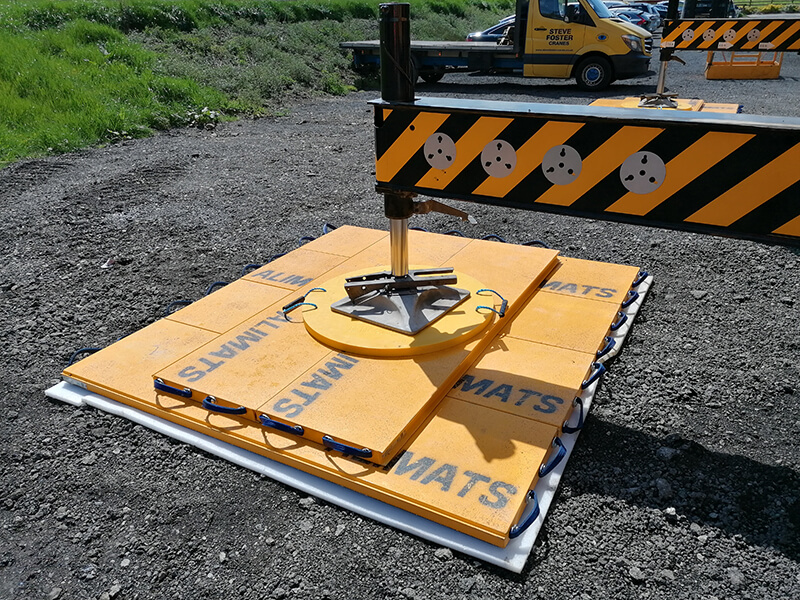
Heat is a design input, not a comfort issue
In the UK our mats spend most of the year working within a fairly narrow, predictable temperature band. Move the same equipment onto a site in the Gulf, North Africa or any comparable hot-climate region and the operating envelope changes completely — sustained ambient temperatures well into the 40s°C, intense direct sun that drives exposed surface temperatures higher still, and a wide daily swing between a cool night and a scorching midday.
That raises three engineering questions a temperate-climate spec sheet never has to answer: how the mat material moves dimensionally as it heats and cools through the day, how any exposed material ages under months of sustained heat and ultraviolet, and how the ground underneath behaves once it has been baked dry rather than left moist. A system that was never thought through against these variables can still look fine on day one — it doesn't collapse under load — while quietly building up problems that only surface later as binding tolerances, embrittled components, or ground assumptions that were never valid to begin with. Heat is a legitimate design input for ground-bearing equipment, and we treat it as one.
Thermal expansion in a modular system
Every solid expands when heated and contracts when cooled, and the rate is set by its coefficient of thermal expansion — a standard material property quoted in parts per million per degree Celsius. Aluminium alloys expand at around 23 x 10⁻⁶ per °C; structural steel at around 12 x 10⁻⁶ per °C, roughly half the rate. These are published physical constants — the same for everyone's aluminium and everyone's steel.
For one solid block those numbers are academic. For a modular system — many separate panels laid edge to edge and interlocked across a working area — they matter directly. On a hot site a mat left in the open runs from a cool overnight minimum to the full weight of midday sun, and a daily swing of 30-40°C is routine across much of the hot desert and steppe world. Every panel grows and shrinks with it. Because our load transfer between panels depends on male/female interlocking geometry to keep everything registered, the clearance built into that geometry has to absorb the full range of expansion and contraction the climate throws at it — not a UK-typical range.
Tolerance a system only against room-temperature assumptions and it will bind at peak heat, when every panel has grown, or lose engagement overnight when the same panels contract again. Design in adequate working clearance across the full expected temperature range and it does neither. It is a fair question to put to any modular ground-protection system heading for a hot climate, whoever makes it.
| Material | Approx. coefficient of thermal expansion (x10-6 per C) | Practical note |
|---|---|---|
Aluminium alloy | ~23 | Uniform, predictable expansion; straightforward to design tolerance around |
Structural steel | ~12 | Roughly half aluminium's rate of expansion |
UHMWPE / HDPE (typical polymer) | ~100-200 | Expands considerably more per degree than either metal |
Timber (along grain) | Low (~3-5), but often a poor predictor of real movement | Moisture-driven dimensional change typically dominates over pure thermal expansion |
Material:
Approx. coefficient of thermal expansion (x10-6 per C):
Practical note:
Material:
Approx. coefficient of thermal expansion (x10-6 per C):
Practical note:
Material:
Approx. coefficient of thermal expansion (x10-6 per C):
Practical note:
Material:
Approx. coefficient of thermal expansion (x10-6 per C):
Practical note:
How sustained heat and UV age different materials
Heat and ultraviolet don't treat every material the same, because the underlying failure mechanisms aren't the same. Polymers such as UHMWPE and HDPE, and organic materials like timber, are open to photo-oxidative degradation — UV photons break down the polymer chains (and, in timber, the lignin) over time, and it shows up as embrittlement, surface chalking, colour fade and a steady loss of the mechanical properties the material started with. It runs faster under the intense, sustained solar load of a desert or subtropical climate than under the moderate UV a UK site ever sees.
Aluminium doesn't share that mechanism. UV photons attack organic polymer chains; they don't act on a metal's crystalline lattice the same way, so our aluminium alloy holds its performance across the full range of environmental temperatures a construction site will ever see, sun included. The real threats to an aluminium panel here are the thermal expansion above and corrosion — and aluminium answers the second itself, forming a thin, self-renewing oxide layer that protects the metal beneath with no applied coating and next to no dependence on climate. This follows straight from what UV physically does, and doesn't do, at molecular level.
Surface temperature and handling safety
There is a more immediate consequence of hot-climate sun that has nothing to do with material failure: surface contact temperature. Any dark surface sitting in strong direct sun — a car bonnet, decking, asphalt, a dark metal or plastic panel — absorbs solar radiation faster than it sheds heat to the air, and climbs well above the ambient temperature on the forecast. A mat that has stood in desert sun for a few hours can be considerably hotter to the touch than the air around it.
We build ALIMATS to be handleable by two people, no heavy plant needed, so this is worth planning around — not because the material has failed in any sense, but as ordinary surface-contact thermal safety. Gloves are the simple answer for anything that has been standing in direct sun, and where you can, scheduling manual handling for the cooler parts of the day, or allowing a short cooling period before bare-handed contact, is sensible operational practice rather than a special precaution. It is the same common sense that already applies to any dark metal tool or fitting left in strong sun — just worth writing into the method statement and the toolbox talk for a hot-climate site, rather than left assumed.
Ground behaviour in arid and desert conditions
Ground-bearing capacity is, at bottom, a property of the specific ground in front of you, and most general guidance on the subject — our own companion guide to ground bearing capacity included — is written around the moist, temperate ground of a typical UK site. Arid and desert ground can behave differently, in ways that UK-oriented guidance doesn't fully reach.
Very dry sand and arid subgrade carry different compaction and bearing characteristics from the moist soils most ground-bearing rules of thumb assume, and near-surface conditions in a hot, arid environment aren't static — daily thermal cycling drives moisture migration and shifts compaction over time, in ways a one-off assessment taken at a different hour or season can miss. Arid and desert ground is a specialism in its own right. For a genuinely arid or desert site we would point you the same way good practice points anywhere: bring in regional geotechnical expertise that understands that specific ground, rather than assuming temperate-climate norms carry across unchanged.
What this means for material choice
Put the three factors together — dimensional stability across a wide temperature swing, immunity to a real UV degradation mechanism, and a handling profile that doesn't depend on polymer chemistry surviving months of sun — and the engineering case for a stable, dimensionally consistent, UV-inert metal system in sustained hot-climate service makes itself. Set it against polymer alternatives that face a genuine degradation mechanism under prolonged, intense UV that metal alloys simply don't, and the choice isn't a close one.
That case is built from material science and first principles, not from a single hot-climate case study. ALIMATS® is exactly the equipment that description points to — moderate, predictable thermal expansion, a corrosion-resistant natural oxide layer, and no UV-driven polymer chemistry to degrade — but the reasoning stands whichever metal ground-protection product a specifier is weighing up. It is engineering logic any competent hot-climate specification can interrogate and check for itself.
What to ask before specifying for a hot climate
If you are specifying ground protection for a genuinely hot-climate project, there is a short, practical list of questions worth putting to any supplier, whatever their system is made from.
Ask what tolerance or expansion allowance has been designed into the interlocking geometry, and across what temperature range it will work without binding or losing engagement. Ask for UV and degradation data on every polymer component in the system, not just the main structural material — it is usually a secondary part that ages first. Ask what surface-temperature handling guidance comes with equipment left in direct sun, especially where manual handling is part of the pitch. And ask — separately from your mat supplier — whether the ground assessment for the specific site has properly accounted for local arid conditions rather than defaulting to temperate assumptions that were never meant for that ground. None of it needs exotic answers. It just needs the heat to have actually been designed for, rather than assumed away.
Frequently asked questions
Does high ambient temperature reduce the load capacity of crane mats?
Not directly, within the temperature ranges you see on a real construction site. Thermal effects show up as dimensional change — expansion and contraction — and, for organic or polymer materials, gradual UV-driven ageing, rather than any immediate drop in load-bearing strength. The bigger capacity question in a hot climate is the state of the ground beneath the mats, which behaves differently once it is arid rather than moist.
Can aluminium crane mats be used in desert or Gulf-region temperatures?
Yes. Aluminium alloys are dimensionally stable and don't suffer the UV-driven degradation that attacks polymers, so a metal ground-protection system is a sound choice for sustained hot-climate use on the materials alone. The design point for any modular metal system is making sure enough tolerance is built into the interlocking geometry to absorb thermal expansion across the site's real daily temperature swing — which is exactly what we design into ALIMATS.
Do plastic (HDPE/UHMWPE) mats degrade faster in strong sun?
Yes. Polymers are open to photo-oxidative UV degradation — UV photons break down the polymer chains over time, showing up as embrittlement, surface chalking and colour fade — and it runs faster under the more intense, more sustained solar exposure of a desert or subtropical climate than on a UK site.
How hot can a mat get sitting in direct sun on a hot-climate site?
Dark metal or plastic surfaces in strong direct sun routinely climb well above the surrounding air temperature — a general, well-known effect rather than anything specific to one material. It is a real handling point: equipment built for manual, two-person handling may need gloves or a short cooling period after standing in direct sun for several hours.
Does thermal expansion actually matter for a modular mat system?
More than it first looks. A modular system relies on interlocking geometry between panels to transfer load and stay registered, and every panel expands and contracts with temperature, so the clearance designed into that geometry has to cover the full daily temperature swing on site, not just typical UK conditions. Poorly toleranced systems bind at peak heat or loosen overnight; a well-designed one does neither.
Is standard UK ground-bearing guidance valid on an arid or desert site?
Not without adjustment. General ground-bearing guidance, including our own, is written around moist, temperate ground, and very dry, arid subgrade carries different compaction and bearing characteristics, sometimes shifted further by daily thermal cycling and moisture migration near the surface. Genuinely arid or desert sites are a specialism of their own and warrant regional geotechnical expertise rather than temperate-climate assumptions.
Does aluminium corrode faster in hot, humid climates?
Aluminium forms its own thin oxide layer that protects the metal beneath with no applied coating, and that protection isn't climate-dependent the way UV degradation of polymers is. Corrosion resistance is a separate question from thermal or UV performance, but it is a genuine strength of aluminium as a ground-protection material across a wide range of environments.
What should I ask a mat supplier before using their product on a hot-climate site?
Ask what tolerance has been designed in to absorb thermal expansion across the site's real temperature range, what UV and ageing data exists for any polymer components, and what handling guidance applies to equipment left in direct sun for long periods. Separately, confirm the ground assessment for the specific site has accounted for local arid conditions rather than defaulting to temperate-climate norms.