
A Region Building at Unmatched Scale
The Gulf has spent well over a decade building at a scale the rest of the world simply doesn't attempt. New cities and giga-scale developments, major sporting and cultural venues, metro and rail networks, ports, and heavy industrial and energy facilities have all gone up concurrently across the UAE, Qatar, Saudi Arabia and their neighbours — often on compressed programmes, and often built out from nothing on land that was open desert a few years earlier.
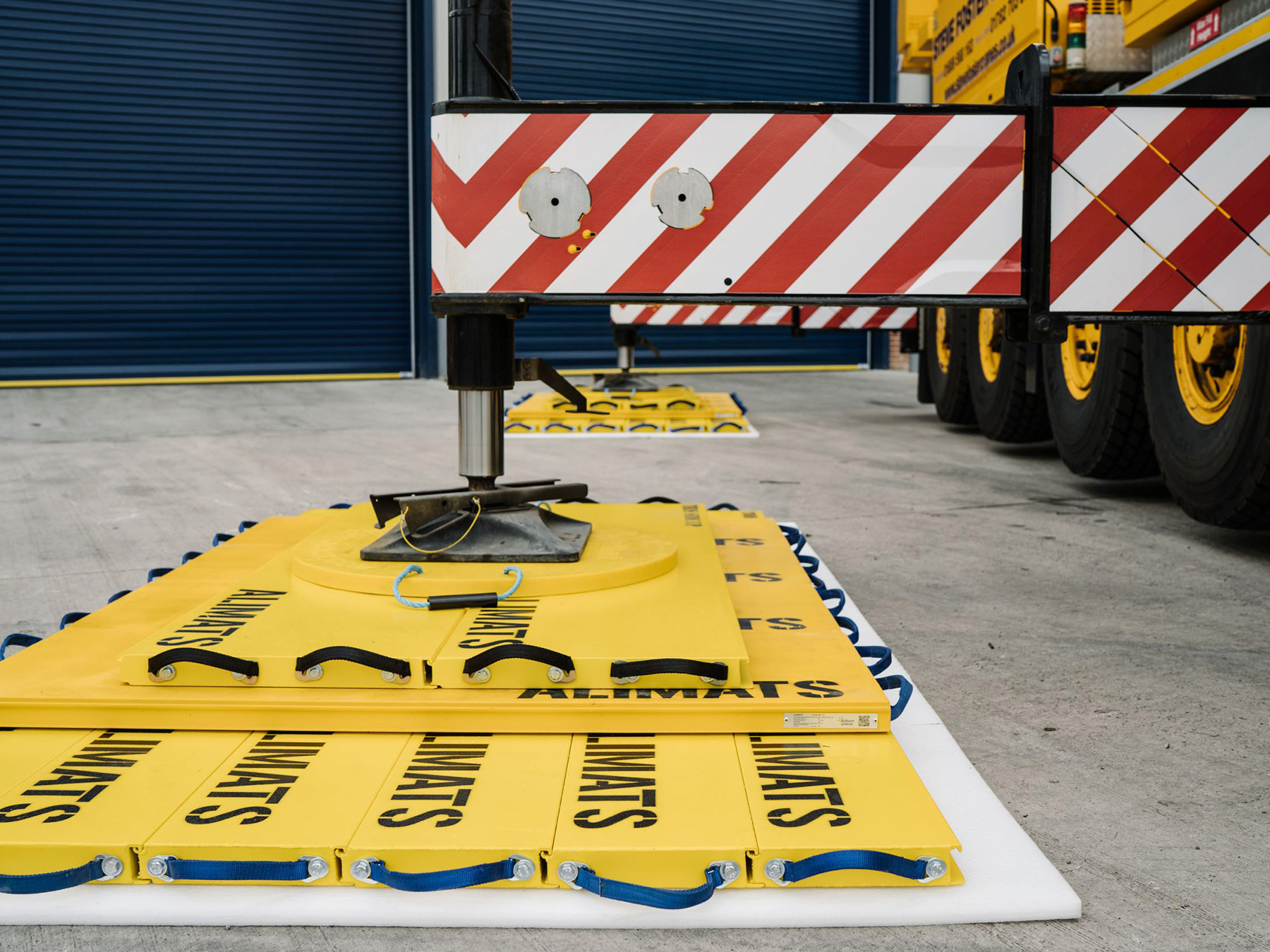
Sustained heavy-lift construction at that volume means sustained demand for temporary works, access and ground protection — every crane on every one of those sites has to stand on something safe. That is the market we manufacture ALIMATS® for, from our facility in Little Eaton, Derbyshire — a patented modular aluminium crane mat system — and it is why we think it is worth setting out plainly why crane matting in the Gulf is not the same problem as crane matting in the UK, even when the crane and the load are identical.
Why Ground Protection Is a Different Problem in the Gulf
It would be lazy to assume a matting solution proven on a UK site drops straight into Gulf conditions unchanged. Four things move the goalposts.
Extreme heat is the obvious one. Sustained high ambient temperatures change how materials behave, force contractors to sequence work around the hottest hours to protect their crews, and compress the usable working day — which leaves far less slack to rework a crane position or a matting layout that wasn't right first time. Get the ground bearing capacity and the mat layout right at the outset and you protect the programme; get it wrong and there is nowhere in the day to absorb the delay.
Ground conditions are the second. Much of the region sits on sandy, loose desert subgrade with variable compaction and bearing characteristics — a different animal to the clay and made ground we design around on most UK sites. A specification that quietly assumes UK-typical subgrade behaviour does not transfer, which is why local ground investigation and bearing capacity assessment matter more in these conditions, not less.
Third is the way the region builds. Modular and off-site construction is everywhere on Gulf megaprojects, and modular build is relentlessly crane-dependent — every panel, pod and module is a lift, and every lift needs safe, level, load-rated ground under the crane and its outriggers. A programme built around thousands of repetitive modular lifts puts a sustained, repeated demand on ground protection that a conventional stick-built site never generates.
And fourth, there is the freight. Equipment made in the UK has to reach site by sea or air, which adds lead time and cost that a locally sourced solution avoids — and it is exactly here that a mat's weight per square metre of coverage stops being an abstract spec and starts driving the shipping bill.
Where ALIMATS Already Travels
ALIMATS already travels well beyond the UK. We have fulfilled a completed export shipment to an offshore oil and gas company in Qatar, and another to an integrated logistics company in Angola — real orders, delivered into the Middle East and Africa.
Alongside those, we have fielded genuine ALIMATS enquiries from Brazil, Angola, Australia, Qatar, Egypt, Argentina, the UAE, Japan, Germany, France, Spain and Belgium. That is interest spread across several continents, and it tells us the load-spread argument for a modular aluminium mat translates as well onto a desert site as it does onto a UK one.
Why Aluminium Suits Hot-Climate Programmes
We have set out the full engineering case for aluminium in our aluminium crane mats guide, so we won't rerun the material science here. In the context of hot-climate, high-throughput construction specifically, three properties do the heavy lifting.
Weight comes first. Aluminium is far lighter than timber or steel, and on anything that has to be freighted rather than sourced locally that weight goes straight to the bottom line — more units per container, more square metres of ground coverage per pallet, a materially lower freight cost for the same protected area. Second, aluminium's natural oxide layer gives it inherent corrosion resistance with no coating to apply or maintain — a plain engineering fact that matters on humid coastal Gulf sites and anywhere exposed to salt air. Third, ALIMATS is handleable: two people can move a panel with no heavy plant needed, which on a labour-intensive programme of repetitive lifts feeds directly into how quickly a crew can reposition and keep the crane working.
Put those three together and you have exactly the profile that makes a modular aluminium mat system worth evaluating for hot-climate, high-throughput conditions — lighter to ship, resistant to a corrosive coastal atmosphere, and fast to lay and lift by hand where the alternative is another piece of plant tying up the site.
Talk to Us Before You Specify
We are a UK manufacturer with a genuine and growing set of international orders and enquiries, and we are building the capability to support larger and more frequent overseas work. If you are handling procurement, temporary works, or plant and equipment sourcing for a project in the Gulf or the wider Middle East, and you are weighing up crane matting and ground protection, we would rather have that conversation early than late.
We will walk you through ALIMATS' configuration range, load capacities and export process, and we will work through your ground conditions, crane loadings and shipping logistics properly before anything is quoted — because on a programme with no slack in the working day, the specification you settle on now is the one that either protects the schedule or costs you it.
Frequently asked questions
Do you supply ALIMATS into the Middle East?
Yes. We have fulfilled a completed export shipment to an offshore oil and gas company in Qatar, and we have received ALIMATS enquiries from Qatar, Egypt and the UAE among other markets.
Do you export ALIMATS crane mats outside the UK?
Yes. We have completed export shipments to an offshore oil and gas company in Qatar and to an integrated logistics company in Angola, and we are building our export capability to support more international orders alongside a steady stream of overseas enquiries.
Why is ground protection a different challenge on Gulf sites than in the UK?
Extreme heat changes how materials behave and compresses the working day, and much of the region sits on sandy, variable desert subgrade rather than the clay and made ground typical of UK sites. Both push ground assessment and matting specification toward a local, first-principles approach rather than a straight transplant of UK practice.
How does modular construction affect crane mat requirements on large programmes?
Modular and off-site construction, common across Gulf megaprojects, runs on crane lifts — every panel and module has to be placed. That puts sustained, repeated demand on stable, load-rated ground beneath the crane and its outriggers for the whole programme, not the occasional lift.
What load capacity do ALIMATS crane mats offer for the large cranes used on major programmes?
ALIMATS carries a safe working load of up to 80 tonnes and is comfortably rated for cranes up to 150 tonnes, independently verified with a Fellow of the Institution of Structural Engineers. Configurations run from 1.34m2 to 8.07m2 depending on your coverage and loading requirements.
Is aluminium a suitable material for crane mats in hot, humid Gulf coastal conditions?
Yes. Aluminium's natural oxide layer gives it inherent corrosion resistance with no coating to apply or maintain, which is exactly what you want on humid coastal sites and anywhere exposed to salt air. We set out the full material case in our aluminium crane mats guide.
How do UK-manufactured crane mats reach an overseas site like the Gulf?
Equipment ships by sea or air depending on your programme timescales and order size, which adds lead time and cost planning a UK-only job never has to consider. We work the shipping route and lead times through properly with each export enquiry.
Which overseas markets have enquired about ALIMATS?
We have received genuine ALIMATS enquiries from Brazil, Angola, Australia, Qatar, Egypt, Argentina, the UAE, Japan, Germany, France, Spain and Belgium — a spread across several continents.