
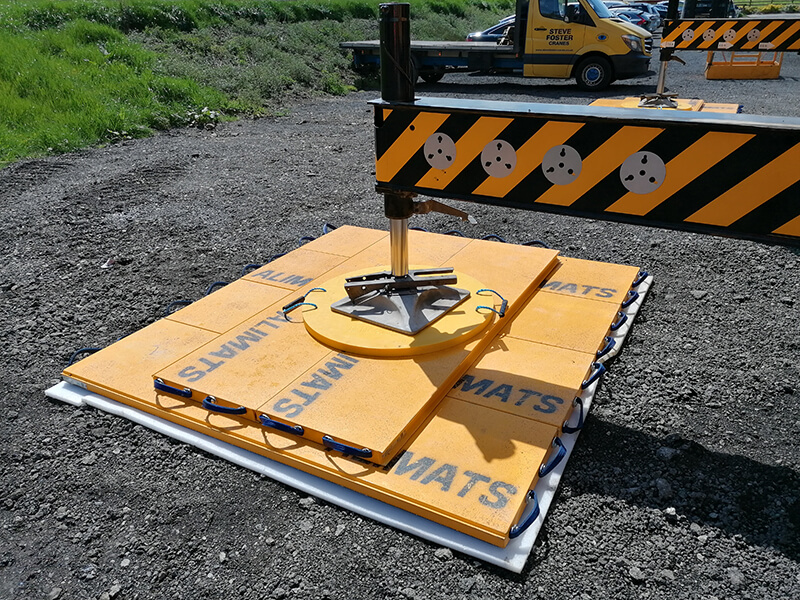
A tonne is a tonne in London, Houston or Singapore, and a square metre is a square metre wherever you measure it. The arithmetic behind ground protection is the same everywhere — take the load a crane or outrigger puts into the ground, divide it by the bearing pressure that ground can safely carry, and you have the area you need to spread that load across. We walk through the whole sum in our companion guide to load spread calculation. It is genuinely universal physics, and it does not change when you cross a border.
What does change is everything wrapped around the physics — which regulator expects the sum to be done, what safety margin gets applied on top of the raw figure, who is named as the responsible person for checking it, and what has to exist in writing before a lift can go ahead. Two contractors on opposite sides of an ocean can run the identical calculation and still end up with meaningfully different practical requirements, because the frameworks around the calculation are not the same. If you are specifying or hiring ALIMATS® ground protection — or any ground protection — for a project outside your home jurisdiction, that gap matters far more than it first looks.
So the sum is the easy part. The rest — units, terminology, who signs, what safety margin is conventional, and what a given country will actually accept as proof — is where cross-border work gets caught out.
Units and terminology are the first thing to trip over
Before you get anywhere near regulatory substance, the units themselves catch people out. Most of the world, the UK and Europe included, works in metric — loads in tonnes or kilonewtons, pressures in kilopascals, areas in square metres. The United States largely works in pounds and pounds per square inch, with areas in square feet. It is the same physical reality in a different language, and the one conversion worth carrying in your head is that a tonne-force is roughly 9.81 kN — enough to sanity-check a figure that has arrived in the wrong units for your habits without reaching for a table.
Terminology is the subtler trap, because the words look familiar even when they do not map cleanly. The role UK practice calls an "appointed person" or a "competent person" — the individual formally responsible for planning or supervising a lift — may exist under a different name, with a different scope of legal responsibility, somewhere else. It might not exist in that form at all, and the duty could sit instead with a licensed operator, a certifying engineer, or a different tier of supervisor entirely. Assuming your own job titles and the authority attached to them travel unchanged is one of the easiest mistakes to make on an international job, and one of the most avoidable.
None of this is exotic — it is the ordinary friction of moving between two countries' technical and legal systems. Ground protection simply is not exempt from it, so budget the time to translate terms properly rather than trusting a like-for-like match.
How the frameworks are organised differs by region
In the UK and much of Europe, ground protection and lifting sit inside a layered structure. Overarching health and safety law sets the general duty of care, harmonised European standards supply the detailed technical requirements that support compliance with it, and industry good-practice guidance fills in the practical detail beneath both. The Health and Safety Executive is the familiar reference point for the legal layer, and our guide to temporary works and permit-to-load shows how that layering plays out for ground protection specifically.
The United States is built differently. The Occupational Safety and Health Administration sets the federal regulatory requirements, and alongside them sits a body of industry consensus standards developed by engineering and trade organisations that OSHA rules often reference or fold in. That relationship between regulator and consensus standard is its own arrangement — different in shape from the UK and European model, even though both are chasing the same outcome: safe, verifiable load spread.
Look further afield and the picture varies again. Some countries run their own national standards bodies with locally written requirements. Others adopt International Organization for Standardization standards more or less wholesale as their national framework. Others blend a local regulatory layer with technical standards imported from elsewhere — sometimes the UK or Europe, sometimes the US — depending on trade ties and historical influence. There is no single global map to memorise. The organising structure has to be checked country by country, project by project.
"It's rated to 80 tonnes" isn't a complete answer everywhere
A stated safe working load feels like a hard, portable fact — the mat carries a given load, full stop. In practice that figure is only as good as the assumptions behind it, and the assumptions are exactly the part that shifts by jurisdiction. What safety factor was applied on top of the tested or calculated capacity? How was the figure established in the first place — physical load testing, engineering calculation, or a combination of the two? What documentation standard was that verification carried out against, and does the country where the mat will actually be used recognise that standard or method as equivalent to its own?
None of those questions has a universal answer, because the conventions genuinely differ. A safety margin treated as standard in one framework may be more conservative, or less, than another framework expects as its baseline. A verification method accepted without a second glance in one country may have to be re-established, re-certified, or independently reviewed before it satisfies another — even though the equipment has not changed at all. The number on the spec sheet travels perfectly. Whether that number, on its own, is enough to satisfy a given jurisdiction is a separate question.
Working across jurisdictions: what to check
Three habits will save you more time and risk than anything else when you are hiring ground protection for a project outside your home country. First, confirm the current local requirements with someone qualified in that jurisdiction rather than assuming home practice carries over — regulatory detail moves over time even within a single country, and no general article is a substitute for a local, current check.
Second, verify how a given capacity was actually established, and whether the country of use recognises that method. Ask for the basis of the figure, not just the figure — what test or calculation was used, and by whom. A vague answer is a signal to dig further before anyone relies on that equipment for a lift.
Third, put real time in the programme for compliance and documentation, rather than treating paperwork as a formality running quietly in parallel with the physical work. On a domestic job the documentation trail is familiar and quick to produce. On an international one, translating requirements, obtaining locally recognised sign-off, and reconciling one country's expectations against another's can take longer than the lift itself — far better to plan for that than to meet it under deadline pressure.
How ALIMATS is verified
Every ALIMATS safe working load — up to 80 tonnes, comfortably supporting cranes up to 150 tonnes — is independently verified with a Fellow of the Institution of Structural Engineers and developed to UK engineering practice. That is a rigorous, genuine verification, and we stand behind it.
UK verification is not the same thing as automatic compliance everywhere, and it never is for any manufacturer's equipment. Whether our figures and the method behind them satisfy a particular country's framework depends on that country's own rules — which is exactly the kind of question we are glad to work through with you. If you are planning a project abroad and need to understand how ALIMATS' verification maps onto your local requirements, that is a specific and worthwhile conversation, and we would far rather have it directly than guess in print.
Frequently asked questions
Does load spread physics actually change from country to country?
No. The relationship between force, bearing pressure and required contact area is the same arithmetic everywhere. What changes at the border is the regulatory framework, the documentation expected, and the conventional safety margins wrapped around that arithmetic — not the physics itself.
Can I just convert a UK-rated safe working load into another country's units and use the figure directly?
The number itself converts cleanly, but the figure alone does not tell you whether the testing regime, safety margin and documentation it was established against are recognised where you are working. Converting units is the easy part. Confirming that a jurisdiction accepts the basis of the figure is the part that needs local, current advice.
Is ISO a single global standard that everyone uses?
ISO is an international standards-setting body, but not every country adopts ISO standards in the same way or to the same extent. Some adopt them closely, some blend them with local or imported regulation, and some rely mainly on their own national frameworks. It is not safe to assume ISO adoption is uniform worldwide.
What's the difference between how the UK and the US regulate lifting and ground protection?
In broad terms, the UK and much of Europe combine general health and safety law with harmonised European standards and industry good-practice guidance. The US works through OSHA regulation alongside industry consensus standards. Both aim at the same safety outcome but are structured differently, which changes what documentation and sign-off look like in practice.
Does an "appointed person" or "competent person" mean the same thing in every country?
Not necessarily. These are specific role titles with defined responsibilities in UK practice. Other countries have equivalent roles for planning and supervising lifts, but the exact title, the scope of authority and the legal responsibility attached can differ — so check the local equivalent rather than assuming a direct match.
Do I need different ground protection equipment for different countries?
Not necessarily — the physical equipment can often be the same, because the physics of load spread does not change. What can differ is whether that equipment's stated capacity and verification method are recognised as sufficient documentation where it is being used. That is a compliance question, separate from whether the equipment is physically suitable.
How much extra time should I allow for compliance on an international project?
There is no single figure that fits every project, because it depends on the jurisdictions involved and how far their documentation expectations sit from what you are used to. Treat compliance and documentation as a genuine work stream with its own timeline rather than something that happens automatically alongside the physical work.
Is ALIMATS' verification recognised outside the UK?
ALIMATS is developed and independently verified to UK engineering practice by a Fellow of the Institution of Structural Engineers. Whether that verification satisfies a specific requirement in another country depends on that country's own framework, so talk to us directly and we will work through any particular international project with you.
Where can I find the actual calculation behind load spread, rather than the regulatory context?
Our dedicated load spread calculation guide walks through the force-over-bearing-pressure arithmetic itself. This piece deals with the regulatory and documentation layer that sits around that calculation internationally, rather than repeating the sum.